
Kairakuen Garden
Ibaraki · Mito
36.3852°N, 140.4461°E
Kairakuen is one of Japan's Three Great Gardens, but unlike the meticulous aristocratic gardens of Kanazawa and Okayama, it was built for commoners. Tokugawa Nariaki, the 9th lord of Mito, opened Kairakuen to the public in 1842 with the philosophy that natural beauty should be shared, not hoarded. The garden centers on 3,000 plum trees of 100 varieties — white, pink, and crimson — that bloom in waves from late February through March.
The experience is less about formal composition and more about walking beneath fragrant plum canopies, discovering hidden tea houses, and climbing Kobuntei Pavilion for views across Senba Lake. The surrounding bamboo grove provides acoustic isolation from the city — the only sound during bloom season is the rustle of wind and the murmur of water. Kairakuen's design embraces natural topography rather than forcing artificial symmetry, creating a landscape that feels less like a display and more like a cultivated forest. This accessibility and naturalism distinguish it from the controlled perfection of Kenrokuen and Korakuen.
Essential Information
Opening Hours
Sunrise to sunset (year-round)
Closed: No closures (open daily year-round)
Entrance Fee
¥320 garden admission (year-round) | Plum festival evening illumination: ¥800–1,000 separate ticket | Matcha at Kobuntei: ¥500
Best Season
Late February–mid-March (plum blossoms, 3,000 trees of 100 varieties)
Visit Duration
1.5–2.5 hours
Getting There
Access Information
Insider Guide
Nearby Spots
The closest hidden gems to Kairakuen Garden, by straight-line distance.
Kodokan
Kodokan was established in 1841 by Tokugawa Nariaki as the educational heart of Mito Domain, embodying the Mito School o…
Howaen
Howaen began as the garden of a temple, was expanded by Tokugawa Mitsukuni in the seventeenth century, and is now a smal…
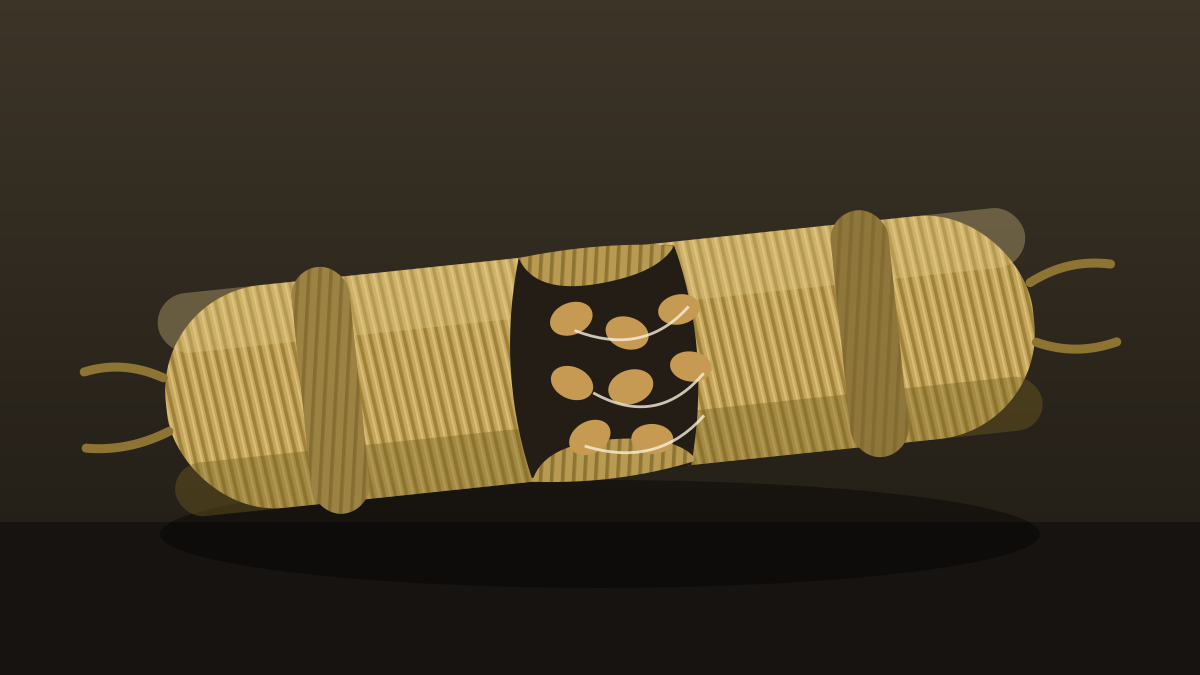 Illustration — not a photograph
Mito Natto
Natto — fermented soybeans bound by sticky, stringy threads — is Japan's most divisive food, beloved by locals and bewil…
Senba Lake Cycling
Senba Lake is a narrow, 12-kilometer-long reservoir on the northern edge of Mito City, created by damming the Naka River…
Shizumine Furusato Park
Almost every cherry blossom site in Japan is somei-yoshino, the pale single-flowered clone that blooms and drops within…

Hitachi Seaside Park
Hitachi Seaside Park transforms twice a year into one of Japan's most photographed landscapes. In late April through mid…
More in Ibaraki
Oarai Fish Market
Oarai Port lands some of the finest Pacific seafood in the Kanto region — flatfish (hirame), Pacific saury (sanma), monk…
Tsukuba Science City
Tsukuba was purpose-built in the 1960s as Japan's science city, a planned urban environment designed to concentrate the…

Mount Tsukuba
Mount Tsukuba is a twin-peaked mountain rising 877 meters from rice fields and suburban sprawl, visible from Tokyo on cl…