
Kyoto
Kyoto was the imperial capital for over a thousand years and it is laid out like one: a grid borrowed from Chinese city planning, numbered streets running east to west, with mountains closing three sides. That basin is why the summers are so oppressive and the winters so damp, and it is also why the temples are pushed up onto the slopes at the edges — the flat centre was for living and trading. The craft economy that served the court survives as working businesses rather than displays, so the dyers in Nishijin and the knife-makers and confectioners around the old market streets are shops you can buy from. The other thing to understand is that Kyoto Prefecture is not Kyoto City: north of the mountains the land drops to the Sea of Japan at Amanohashidate and Ine, where boathouses stand with their ground floors open to the water, and almost nobody who visits the city goes there.
15 spots
Esta prefectura llega al mar de Japón, y casi nadie va
What visitors mean by the name is a city in a basin. The administrative prefecture keeps going north over the mountains and comes out on the Sea of Japan, where there is a long sandbar covered in pines and a fishing village whose houses stand directly over the water with boat garages at ground level and living quarters above.
It is roughly two hours from the city by limited express and it is a completely different country: quiet, weather-beaten, and empty of the crowds that define the south. If you are giving the region four or five days, spending one night up there is the single best swap available — better than a fourth day of temples, and the thing almost nobody plans for. Go by train to the sandbar and take the bus round the bay to the boathouse village; sleeping in one of the houses is possible and is the point of the journey.
¿Cuántos días hacen falta?
Four days for the city, and the single most useful thing to know is that the prefecture extends far north to the Sea of Japan and that almost nobody goes. Kyoto City is what people mean by Kyoto; the northern coast at Amanohashidate and the fishing village of Ine are two and a half hours away and belong to a different trip.
Within the city, plan by district and not by list. Higashiyama in the east, Arashiyama in the west and the northern hills are three separate days, and crossing between them takes forty minutes on a bus in traffic. Trying to do a temple from each in one day is the standard visitor mistake and it produces a day of transport.
Five or six days lets you add Uji for tea and the Byodo-in, about twenty-five minutes south, and one night on the northern coast, which is the best thing in the prefecture almost nobody plans for.
El centro llano era para vivir, así que los templos subieron a las laderas
The city was laid out on a grid borrowed from Chinese planning, with numbered streets running across it and mountains closing three sides of the basin. The flat middle was for the court, the merchants and the workshops — which is why so many of the famous temples are not in the centre at all but pushed up onto the eastern and western slopes where the land was cheaper and the setting better.
Two useful things follow. Navigation is easy once you notice that many street names are numbers, and directions given as combinations of two street names are exact rather than approximate. And the sightseeing districts are up against the hills on opposite sides of a flat city, which is why crossing from one to the other takes most of an hour in traffic. Plan one side per day, use a bicycle across the flat middle, and let the basin's shape do the scheduling for you.
Cómo moverse
Kyoto Station is a Tokaido Shinkansen stop, about two and a quarter hours from Tokyo and fifteen minutes from Shin-Osaka; Kansai International is roughly 75 minutes away by the Haruka limited express. Inside the city, buses reach more temples than the two subway lines but they are slow and crowded, so cycling is genuinely the fastest way across the flat centre and rental is cheap. The Keihan and Hankyu lines are quicker than JR for the eastern and western hills. For the north coast, the JR Hashidate limited express runs to Amanohashidate in about two hours from Kyoto, and Ine needs a bus from there.
Cuándo no ir
The first three weeks of April and the second half of November, unless you accept what they are. Cherry blossom and maple foliage in Kyoto are genuinely among the best in the world and they are also the two periods when the city is at capacity — accommodation at double the price, queues at every major temple, and buses too full to board.
August is hot and humid in a basin that traps both, though the Gion festival in July and the mountain fires in mid-August are worth enduring it for. The best windows are late May to June, when the moss and the rainy-season gardens are at their peak, and January to February, when the city is cold, clear and comparatively empty.
Cuándo ir
The two peak weeks — cherry blossom in the first days of April and maple colour in the second half of November — are also when the city is at its least pleasant to walk through. If you come then, be at Fushimi Inari or Arashiyama by seven in the morning. Summer is the hardest season: August routinely exceeds 35°C with humidity the basin will not release, though Gion Matsuri fills July and the Daimonji bonfires burn on August 16. Winter is cold, damp and quiet, with January highs near 9°C and occasional snow that transforms the northern temples. Late May and early October are the underrated months.
Clima y mejor temporada
Clima de cuenca: veranos húmedos de fama temible e inviernos penetrantes y húmedos. Principios de abril y finales de noviembre son el pico (y la aglomeración).
Gastronomía típica
- Kaiseki
- Yudofu
- Matcha y wagashi
- Cocina casera obanzai
Lugares emblemáticos
- Fushimi Inari
- Kinkakuji y Ginkakuji
- Arashiyama
- Amanohashidate e Ine en la costa norte
Comida local
Kyoto cooking was shaped by distance from the sea: vegetables, tofu, preserved fish and a great deal of technique. Kaiseki is the formal expression and needs booking well ahead; obanzai, the everyday home style, is served in small plates at counters and is the cheaper way to understand it. Yudofu, simmered tofu, is a temple dish sold along the Nanzenji and Arashiyama approaches. Uji, just south of the city, has grown tea since the twelfth century and supplies most of the matcha used in the tea ceremony, along with the wagashi that accompany it.
¿Coche o tren?
Never a car in the city. Kyoto's buses are comprehensive and crowded, its two subway lines are limited, and the private railways to Arashiyama, Uji and the north are the fastest way to move. Walking and a bicycle are both genuinely competitive with the bus over short distances, and a bicycle is the single best way to see the flat central grid.
A car is useful only for the north of the prefecture, where the coast, the boat-houses at Ine and the inland valleys are poorly connected. If you are going that far, the limited express from Kyoto Station to Amanohashidate takes around two hours and a car hired at the far end makes more sense than driving from the city.
Primera visita y regreso
A first visit should choose fewer temples and earlier mornings. Most of the famous sites open at or before eight, and the difference between a temple at eight and the same temple at eleven is the entire difference between the experience people describe and the experience they have. Two or three sites a day, in one district, on foot.
A second visit should go north. Amanohashidate's pine sandbar and the boat-house village at Ine, where the ground floors are garages for fishing boats and the families live above them, are in the same prefecture as the shrine you queued at, two hours away, and effectively unvisited by international travellers. Add Uji for the tea, and Ohara or Kurama in the northern hills for temples with no crowd at all.
Dónde ir, según el tiempo que exige
Short stops within a single district
11 lugares
An hour or less: a sub-temple, a garden, a shrine, a market lane, a tea house. Kyoto has more of these than any city in Japan and the correct way to use them is to stay inside one district — Higashiyama, Arashiyama, the centre — rather than crossing town between them. Crossing is what eats a Kyoto day; adjacency is what makes it work. Go early, since most of the grounds open long before the ticketed halls and the first hour is the quietest of the day by a wide margin.
Kifune Shrine
An hour or less on site, reachable on public transport. Summer and winter is the season for it.
Katsura Imperial Villa
An hour or less on site, reachable on public transport. Under ¥1,000. Spring and autumn is the season for it. Within an hour of Kyoto Station.
Shosei-en Garden
An hour or less on site, reachable on public transport. Under ¥1,000. Open all year.
 Ilustración: no es una fotografía
Eikan-do Temple
An hour or less on site, reachable on public transport. Under ¥1,000. Open all year, at its best in autumn and winter.
Heian Shrine
An hour or less on site, reachable on public transport. Spring, summer and autumn is the season for it.
Kamo River Noryo-yuka
An hour or less on site. Free to enter. Spring and autumn is the season for it.
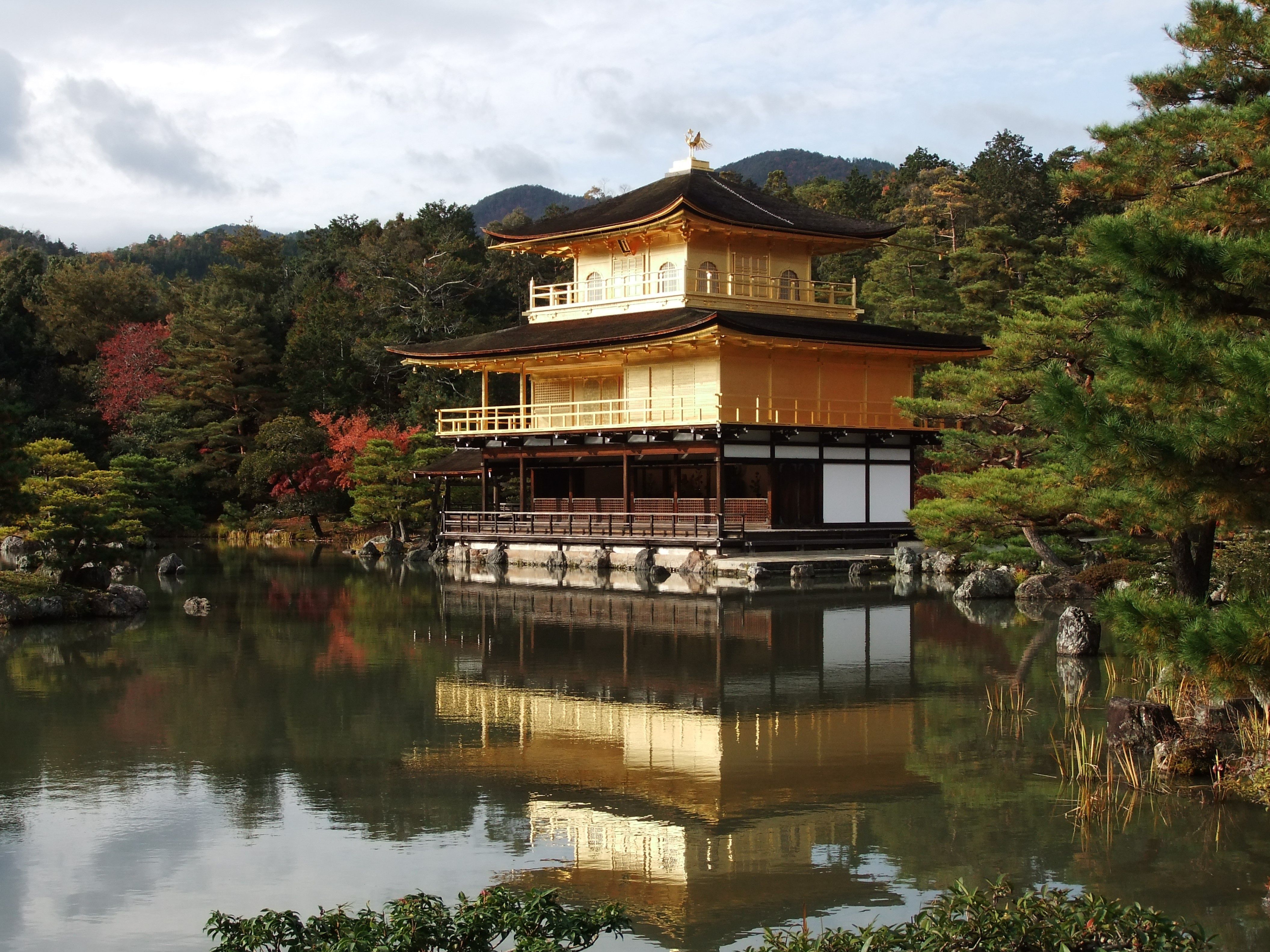 Pexels
Kinkaku-ji Golden Pavilion
An hour or less on site, reachable on public transport. Under ¥1,000. Spring, autumn and winter is the season for it. Within an hour of Kyoto Station.
Kiyomizu-dera
An hour or less on site, reachable on public transport. Under ¥1,000. Open all year. Within half an hour of Kyoto Station.
Philosopher's Path
An hour or less on site. Free to enter. Spring, summer and autumn is the season for it.
Ginkaku-ji Silver Pavilion
An hour or less on site, reachable on public transport. Under ¥1,000. Spring and autumn is the season for it.
Ryoan-ji Rock Garden
An hour or less on site, reachable on public transport. Under ¥1,000. Open all year, at its best in spring and autumn.
Half days by bus, rail and bicycle
4 lugares
Three or four hours each: the major temple complexes, the bamboo grove and the western hills, Fushimi's shrine paths, Uji's tea town. Everything here is on a bus or a private line, and in the flat centre a bicycle beats both. Plan two of these in a day at most, in adjacent areas, and put the busiest one first — the queues at the headline sites build from mid-morning and do not clear again until the ticket offices close. The bus is comprehensive and slow; on the flat, a bicycle beats it comfortably.
Kurama-dera Temple
Half a day on site, reachable on public transport. Under ¥1,000. Spring and autumn is the season for it.
 Ilustración: no es una fotografía
Sento Imperial Palace
Half a day on site. Free to enter. Spring and autumn is the season for it.
Daitoku-ji Temple Complex
Half a day on site, reachable on public transport. Open all year, at its best in autumn.
Tofuku-ji Temple
Half a day on site, reachable on public transport. Under ¥1,000. Spring and autumn is the season for it.
Enlaces relacionados
Historias sobre Kyoto
- Where a Japanese City Actually Eats
- The Four Weeks Not to Travel in Japan
- The Fox at the Shrine Gate Is Japan's Most Complicated Spirit
- Japanese Addresses Don't Work Like Yours
- One Quiet Day in Kyoto: Zen Gardens to a Lantern-Lit Dinner Alley
- Kyoto's Vengeful Spirits and the Night Parade of a Hundred Demons