
이 페이지는 아직 번역되지 않아 영어로 표시됩니다.
Oarai Aquarium
조사·집필 Hinato

Photo: 出羽雀台 / Wikimedia Commons (CC BY-SA 4.0) · original
Aqua World Oarai is one of Japan's largest aquariums, specializing in sharks (54 species, the most of any aquarium in Japan) and jellyfish (360° jellyfish hall). The facility houses 580 species in 60 tanks, including Pacific-focused exhibits: sunfish (mola mola), sea turtles, deep-sea giant isopods, and the main Oceanic Tank — a 1,300-ton basin where 20,000 sardines swirl in synchronized schools around sharks, rays, and tuna.
The shark collection ranges from docile nurse sharks to aggressive bull sharks and graceful hammerheads. The jellyfish hall is a darkened circular room where backlit tanks display moon jellies, flame jellies, and rare box jellies pulsing in slow motion. The aquarium also operates a sea otter exhibit, penguin beach, and daily sea lion shows. What distinguishes Aqua World from Tokyo's larger Shinagawa or Osaka's Kaiyukan is its focus on local Pacific marine biodiversity — the exhibits explain the Oyashio and Kuroshio currents, deep-sea ecology, and sustainable fishing. It is education disguised as spectacle.
Oarai's location on the Ibaraki coast is itself part of the exhibit's logic: the town sits near the boundary where the warm Kuroshio current flowing north meets the cold Oyashio current flowing south, a mixing zone that produces one of the richest and most biodiverse fishing grounds in Japan, and the aquarium was built specifically to interpret that local phenomenon rather than to assemble a generic global collection. The 54-species shark hall exists for the same reason — Ibaraki's offshore waters see an unusually wide range of shark species pass through as the two currents shift seasonally, giving local researchers material that aquariums elsewhere in the country simply don't have access to. That research role isn't incidental to the public displays either; several of the tanks double as breeding and study programs for species whose populations are otherwise hard to monitor at sea, and signage throughout the building leans into explaining current systems and fisheries management rather than treating the animals purely as spectacle.
기본 정보
영업시간
9:00 AM – 5:00 PM daily | Dolphin/sea lion shows: 11:00 AM, 1:30 PM, 3:30 PM (weekends)
휴무일: Open year-round
입장료
¥2,300 adults | Shows and exhibits included | Behind-the-scenes tour: ¥500 extra (weekends, reservation required)
베스트 시즌
Year-round (indoor aquarium) | Summer for combined beach and aquarium activities
방문 소요 시간
2–3 hours
가는 방법
교통 정보
인사이더 가이드
주변 스팟
Oarai Aquarium에서 직선거리로 가장 가까운 히든 스팟들입니다.
 이미지 일러스트 (사진이 아닙니다)
Kamiiso no Torii
Little knownA single vermilion torii gate stands on a jagged rock platform where waves explode into white spray at high tide. Kamiis…
 江戸村のとくぞう (Edomura no Tokuzo) / CC BY-SA 4.0
Nakaminato Fish Market
Little knownNakaminato is a working fishing port on the Ibaraki coast and the market beside it is where the boats' catch is sold dir…
Oarai Fish Market
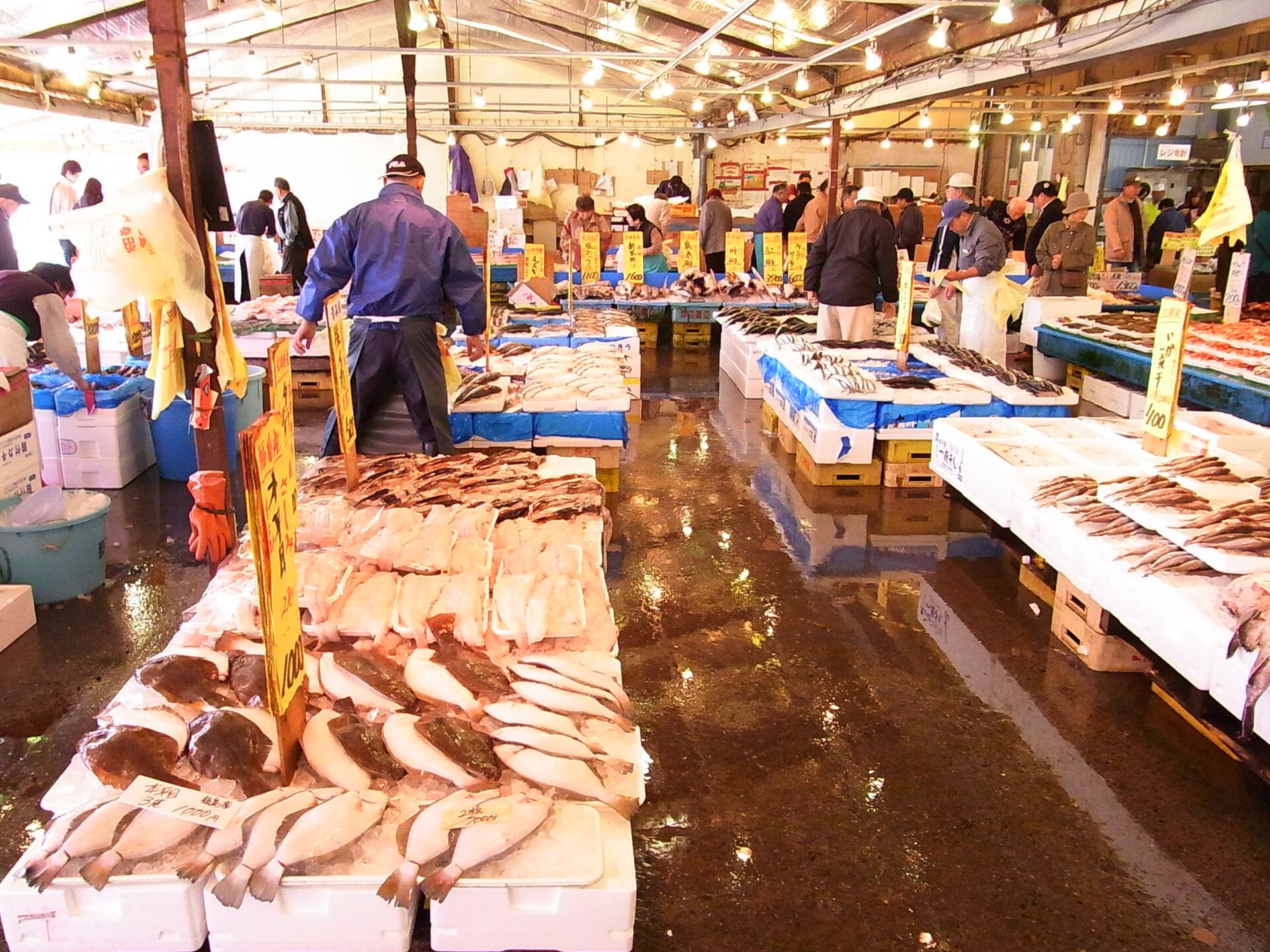
Little knownOarai Port lands some of the finest Pacific seafood in the Kanto region — flatfish (hirame), Pacific saury (sanma), monk…
 Σ64 / CC BY 3.0
Oarai Beach
Little knownOarai Sun Beach is a 1.5-kilometer crescent of pale sand facing the Pacific, backed by pine groves and bordered by rocky…
 Σ64 / CC BY 3.0
Ajigaura Beach
Little knownAjigaura Beach is a 4-kilometer stretch of sandy coastline facing the open Pacific, known as one of Kanto's best surf br…
 くろふね / CC BY 3.0
Hitachi Seaside Park
Well knownHitachi Seaside Park transforms twice a year into one of Japan's most photographed landscapes. In late April through mid…
이바라키현의 다른 스팟 더 보기
 t.kunikuni / CC BY-SA 2.0
Tsukimachi Falls
Little knownTsukimachi is 17 metres high and 12 metres wide and comes down in three separate strands, and its local name is the fall…
Izura Rokkakudo
Little knownOkakura Tenshin wrote The Book of Tea, ran the Tokyo School of Fine Arts, curated Asian art in Boston, and argued that A…
Makabe Historic District
Locally knownMakabe began as the castle town of the medieval Makabe clan and grew into a market town under the Tokugawa, and the stre…