
Miyazaki Hidden Gems
Miyazaki records more sunshine hours than almost anywhere in Japan and its coast is lined with palms, which made it the national honeymoon destination in the 1960s and 70s before cheap flights to Hawaii took that away — the resort infrastructure from that period is still visible along the Nichinan road. The other Miyazaki is inland and much older. Takachiho, in the northern mountains, is where the sun goddess is said to have hidden in a cave, and the village has performed the yokagura dances retelling that story through winter nights for centuries; the gorge below it is a column-jointed lava canyon that you row through in a rented boat. On the coast, Udo Shrine is built into a cave in a sea cliff and Aoshima is ringed by a wave-cut rock shelf that locals call the devil's washboard. Surf breaks run most of the coastline, and Miyazaki has produced a disproportionate number of Japan's competitive surfers because of it.
30 spots
Climate & Best Season
Warm, sunny and typhoon-exposed, with the most sunshine hours in Japan and very mild winters. Good year-round.
Famous For (Food)
- Chicken nanban
- Miyazaki beef
- Hiyajiru
- Mango
Signature Sights
- Takachiho Gorge
- Udo Shrine
- Aoshima's 'devil's washboard'
- Nichinan coast
When to Go
Winters here are the mildest on Kyushu's main island, with January highs near 13°C and heavy sunshine, which makes January and February genuinely good months to visit. Summers are hot and humid above 32°C, and this coast takes typhoons directly from August into September — more of them than most of Japan. June brings sustained rain to the Takachiho uplands. Takachiho's all-night kagura performances run in village halls from November to February, while the shrine's nightly abridged version runs year-round. Mango season is May and June. Surf is biggest with autumn swells.
Getting Around
Flying is the sensible option: Miyazaki Airport is about an hour and three quarters from Haneda and ten minutes from the city by train. There is no shinkansen, and reaching Miyazaki overland from Hakata means either a limited express down the east coast of Kyushu of over five hours or the Kyushu Shinkansen to Kagoshima and a bus across. The JR Nichinan line runs south along the coast to Aoshima and Obi. Takachiho is the hard one — its railway closed years ago, so it is a bus of around three hours from Miyazaki or two from Kumamoto, or a drive. A car makes the Nichinan coast much better.
Local Food
Chicken nanban is fried chicken dipped in sweet vinegar and topped with tartare sauce, invented in Nobeoka in the 1950s and now eaten across the country. Miyazaki beef has won the national wagyu championship repeatedly. Hiyajiru is a cold soup of grilled fish, miso and cucumber poured over rice, a summer field-worker's meal. Jidori, charcoal-grilled free-range chicken served blackened in an iron pan, is the standard izakaya order. Mangoes ripen in May and June and the top-graded fruit is sold individually at prices that surprise people.
Shiiba Village
Shiiba is counted with Shirakawa-go and the Iya valley as one of Japan's three great hidden regions, and the reason is t…
Mimitsu
Mimitsu was the port of the Takanabe domain at the mouth of the Mimitsu river, and in the late Edo and Meiji periods its…
Umagase
Umagase is the tip of the Hyuga peninsula, where cliffs of columnar-jointed welded tuff drop seventy metres into the Pac…
Ebino Kogen
Ebino Kogen is a plateau at around 1,200 metres in the Kirishima volcanic range, and it is the base for the climb up Kar…
Saitobaru Burial Mounds
Three hundred and nineteen burial mounds stand on a plateau outside Saito, built between the late third and the seventh…
Aya Teruha Suspension Bridge
The bridge is 250 metres long, 1.2 metres wide and 142 metres above the Ayaminami river, which for a long time made it t…
Kunimigaoka
Kunimigaoka is a ridge above the Takachiho basin where, according to the legend, Takeiwatatsu — a grandson of Emperor Ji…
Hiyajiru
Hiyajiru is a cold soup poured over rice: grilled and ground dried fish, sesame and miso, thinned with cold dashi and fi…
Lettuce Maki
In 1966 the owner of a sushi shop in Miyazaki City made a roll of boiled prawn, lettuce and mayonnaise. At the time raw…
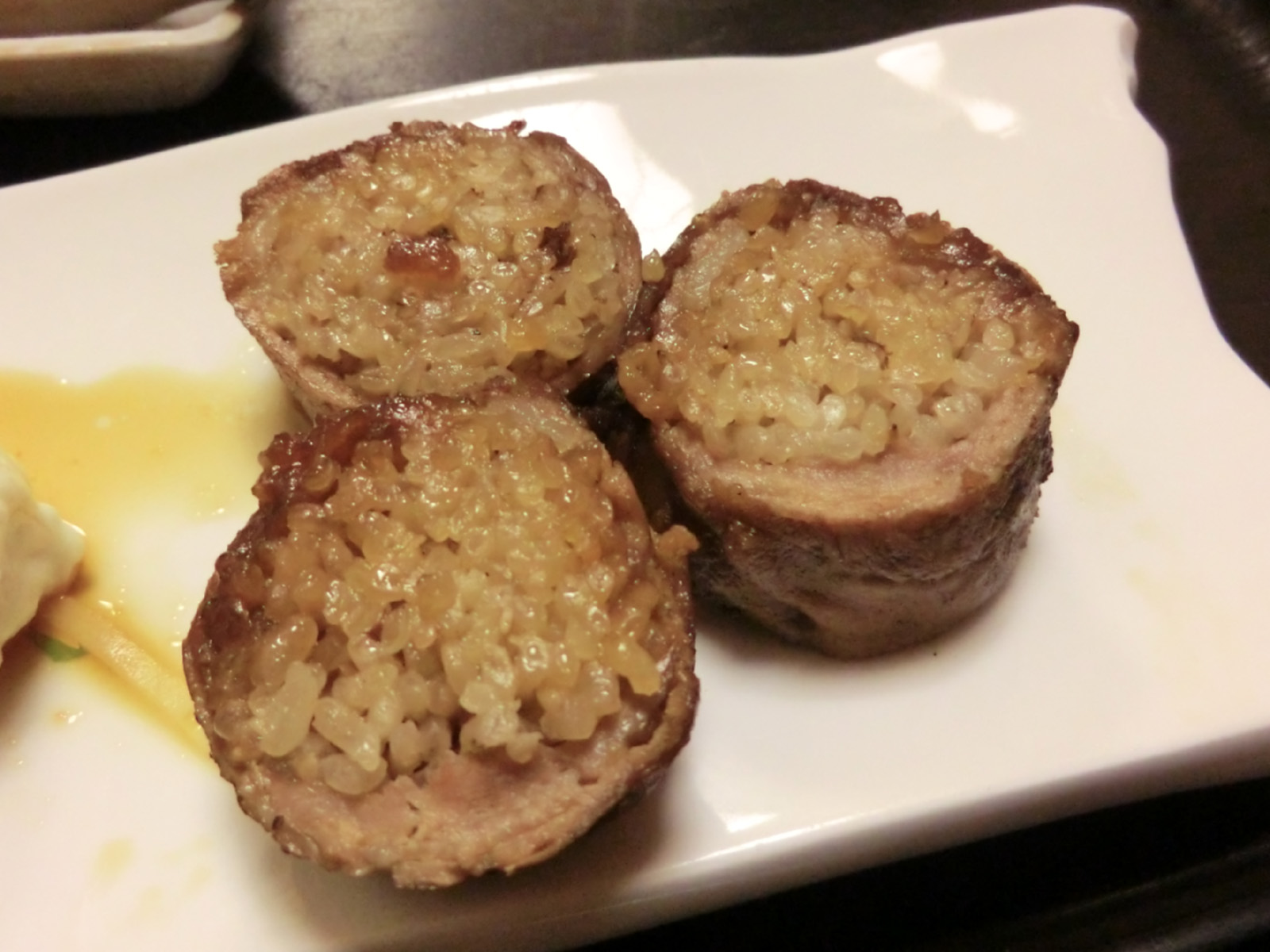
Nikumaki Onigiri
A rice ball wrapped in marinated pork belly, roasted until the outside caramelises, and wrapped again in a lettuce leaf.…
Kirishima Onsen Village
The Kirishima volcanic plateau sits at 600–1,700 meters elevation, where two dozen active and dormant volcanoes have sha…
Cape Toi (Misaki Horses)
Cape Toi (Toi Misaki) is famous for its free-roaming Misaki horses — one of Japan's eight native horse breeds. Around 10…

Miyazaki Beef
Miyazaki cattle are born from specific bloodlines traced back to a prize bull named Monjiro (foaled 1989). Calves spend…

Aoshima Island
Aoshima is a small island (1.5km circumference) connected to the mainland by a walking bridge, famous for two features:…
Takachiho Gorge
Takachiho Gorge is one of Japan's most dramatic natural landscapes, carved by the Gokase River through ancient volcanic…
Gunkei Kakushigura
Tucked inside a narrow alley off Chuo-dori, Gunkei Kakushigura is one of Miyazaki City's most celebrated specialists in…
Suisen
Suisen is an intimate yakitori bar that seats only 20 guests and revolves entirely around Miyazaki chicken grilled over…
Miyazaki City Phoenix Zoo
Miyazaki City Phoenix Zoo is set on a hillside overlooking the Pacific Ocean, housing 1,200 animals with particular focu…
Obi Castle Town
Obi was a castle town ruled by the Ito clan for over 400 years, preserving Edo-period streetscapes with samurai residenc…
Udo Jingu Shrine
Udo Jingu is one of Japan's most dramatically sited shrines — built inside a seaside cave carved into volcanic cliffs, w…
Omi Shrine
Omi Shrine (大御神社) is a coastal Shinto shrine perched on rocks directly facing the Pacific Ocean, famous as one of Japan'…
Amano Yasukawara Cave
Amano Yasukawara (天安河原) is a large riverside cave along the Iwato River, believed to be the site where 8 million kami (g…
Heiwadai Park
Heiwadai Park features the Peace Tower (平和の塔) — a 37-meter stone monument built in 1940 to commemorate the 2,600th anniv…
Takachiho Yokagura
Between mid-November and early February, 20 villages across Takachiho hold all-night kagura ceremonies in private homes…
Togakushi Udon
Togakushi is Miyazaki City's most beloved udon shop, set in a vast hall that was once a ballroom dance school. Their kam…
Miyazaki Jingu
Miyazaki Jingu is one of Kyushu's most important shrines, dedicated to Emperor Jimmu — Japan's legendary first emperor w…
Sun Messe Nichinan
Sun Messe Nichinan is a hillside park featuring seven full-scale Moai statues — officially licensed replicas of Easter I…

Takachiho Amaterasu Railway
The Takachiho Railway line was permanently closed after a typhoon in 2005 destroyed sections of track. Rather than resto…
Ogura Honten
Ogura Honten is the legendary restaurant that invented Chicken Nanban with tartar sauce — one of Japan's most beloved co…
Fruits Garden Nagano
Miyazaki produces over 60% of Japan's premium Taiyo no Tamago mangoes. Fruits Garden Nagano is a family-run greengrocer-…