
Horyuji Temple
Facts verified: August 2026 · Sources: yamatoji.nara-kankou.or.jp

Photo: z tanuki / Wikimedia Commons (CC BY 3.0)
Horyuji (法隆寺) is a UNESCO World Heritage temple containing the world's oldest surviving wooden structures — the Main Hall (Kondo) and Five-Story Pagoda date to 607 AD (or 670 AD reconstruction after fire, debated by scholars), making them over 1,300–1,400 years old. That these wooden buildings have survived earthquakes, fires, and typhoons for over a millennium is testament to ancient Japanese joinery techniques that allow flexing without collapse.
The temple was founded by Prince Shotoku (574–622), who established Buddhism as Japan's state religion and created the Seventeen-Article Constitution. The complex contains over 190 buildings across two precincts (Western and Eastern) with 2,300+ cultural properties. The Treasure House displays Buddhist art from the Asuka Period (538–710), including the Tamamushi Shrine — a miniature shrine decorated with iridescent beetle wings. The temple's scale, antiquity, and art collection make it one of Japan's most important cultural sites, yet it remains less crowded than Todaiji or Kiyomizudera due to its distance from central Nara.
Horyuji's survival across fourteen centuries owes as much to the surrounding Ikaruga area's relative isolation as to the resilience of its construction — because the capital moved away from this part of the Yamato Plain not long after the temple's founding, Horyuji never sat at the center of the political upheavals, urban fires, and repeated rebuilding that reshaped so many temples closer to later capitals. This relative quiet allowed the complex to accumulate its buildings and treasures gradually rather than losing them in the kind of catastrophic single event that destroyed structures elsewhere in Japan. The temple's role as a training and study center for Buddhist scholarship also shaped its character over the centuries, drawing monks focused on textual study and ritual practice rather than the political maneuvering that entangled some larger urban temples. Walking between the Western and Eastern precincts today, visitors move through what is effectively a timeline of Japanese Buddhist architecture and art, since later halls were added over centuries without demolishing what came before, leaving styles from different eras standing side by side rather than replacing one another.
Essential Information
Opening Hours
8:00 AM – 5:00 PM (February 22 – November 3) | 8:00 AM – 4:30 PM (November 4 – February 21). Last entry 30 minutes before closing.
Closed: Open year-round
Entrance Fee
¥2,000 adults, university and high school | ¥1,700 middle school | ¥1,000 elementary — covers all three precincts
Best Season
Year-round | Spring (early April, cherry blossoms on grounds) | Autumn (November, serene foliage + fewer crowds)
Visit Duration
2–3 hours (Western + Eastern precincts + Treasure House)
Getting There
Access Information
Insider Guide
Book Your Stay Nearby
Find accommodation close to Horyuji Temple on these trusted booking platforms:
Nearby Spots
The closest hidden gems to Horyuji Temple, by straight-line distance.

Yakushiji Temple
Yakushiji (薬師寺) is a UNESCO World Heritage temple founded in 680 AD, famous for its twin pagodas flanking the Main Hall…
Toshodaiji Temple
When the Chinese monk Jianzhen finally reached Japan in 754 AD after five shipwrecks, pirate attacks, and twelve years a…

Nara Park
Nara Park (奈良公園) is a 660-hectare park where over 1,200 wild sika deer roam freely among visitors, temples, and open mea…
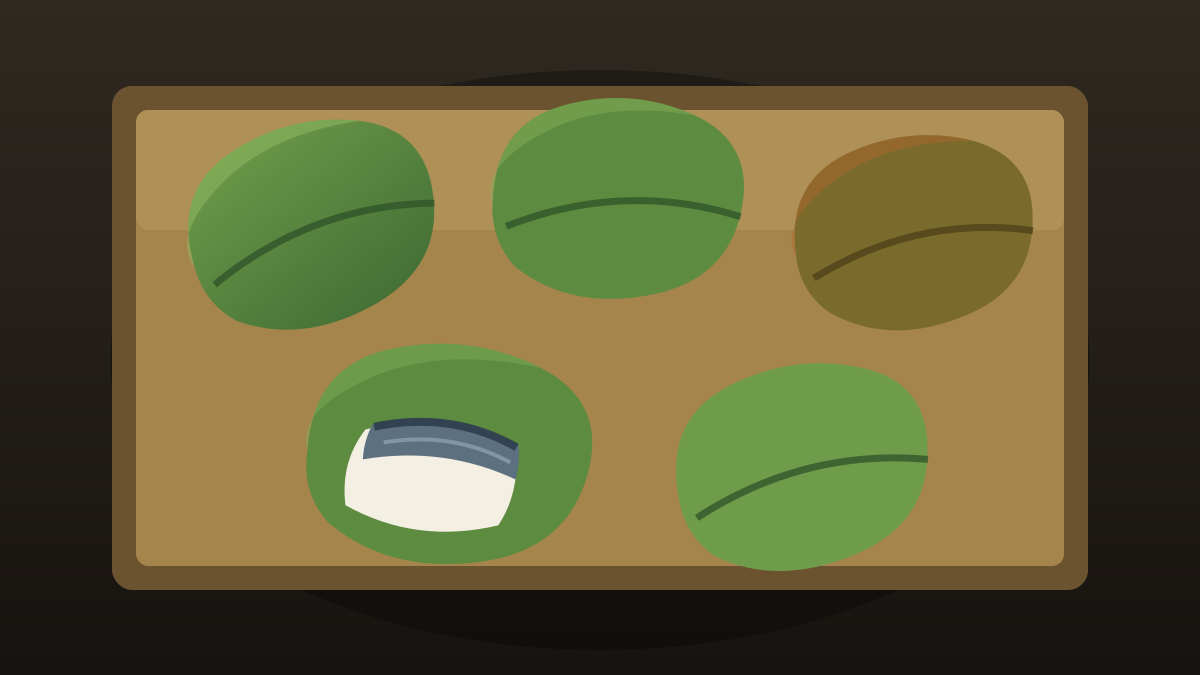 Illustration — not a photograph
Kakinoha-zushi
Kakinoha-zushi (柿の葉寿司) is Nara's signature pressed sushi: vinegared rice topped with mackerel, salmon, or sea bream, wra…
 Illustration — not a photograph
Narazuke Pickles
Narazuke (奈良漬) are vegetables pickled in sake kasu (酒粕, sake lees — the fermented rice solids left after sake brewing),…
Nara Sake
Nara is the birthplace of sake brewing's key innovations — monks at Shoryakuji Temple (菩提山正暦寺) invented the bodaimoto me…
More in Nara

Heijo Palace Site
Heijo Palace (平城宮跡, Heijo-kyo) was the imperial palace during Nara's time as Japan's capital (710–784 AD), occupying 120…
Nara-machi Koshi-no-ie
Naramachi Koshi-no-ie (奈良町格子の家) is a preserved Edo Period machiya (merchant townhouse) opened as a free museum showing t…
Nara Park Maple Viewing
Nara Park transforms in autumn (mid-November to early December) when 2,000+ maple, ginkgo, and cherry trees turn vibrant…