
Cette page n'a pas encore été traduite et s'affiche en anglais.
Oarai Aquarium
Recherche et rédaction Hinato

Photo: 出羽雀台 / Wikimedia Commons (CC BY-SA 4.0) · original
Aqua World Oarai is one of Japan's largest aquariums, specializing in sharks (54 species, the most of any aquarium in Japan) and jellyfish (360° jellyfish hall). The facility houses 580 species in 60 tanks, including Pacific-focused exhibits: sunfish (mola mola), sea turtles, deep-sea giant isopods, and the main Oceanic Tank — a 1,300-ton basin where 20,000 sardines swirl in synchronized schools around sharks, rays, and tuna.
The shark collection ranges from docile nurse sharks to aggressive bull sharks and graceful hammerheads. The jellyfish hall is a darkened circular room where backlit tanks display moon jellies, flame jellies, and rare box jellies pulsing in slow motion. The aquarium also operates a sea otter exhibit, penguin beach, and daily sea lion shows. What distinguishes Aqua World from Tokyo's larger Shinagawa or Osaka's Kaiyukan is its focus on local Pacific marine biodiversity — the exhibits explain the Oyashio and Kuroshio currents, deep-sea ecology, and sustainable fishing. It is education disguised as spectacle.
Oarai's location on the Ibaraki coast is itself part of the exhibit's logic: the town sits near the boundary where the warm Kuroshio current flowing north meets the cold Oyashio current flowing south, a mixing zone that produces one of the richest and most biodiverse fishing grounds in Japan, and the aquarium was built specifically to interpret that local phenomenon rather than to assemble a generic global collection. The 54-species shark hall exists for the same reason — Ibaraki's offshore waters see an unusually wide range of shark species pass through as the two currents shift seasonally, giving local researchers material that aquariums elsewhere in the country simply don't have access to. That research role isn't incidental to the public displays either; several of the tanks double as breeding and study programs for species whose populations are otherwise hard to monitor at sea, and signage throughout the building leans into explaining current systems and fisheries management rather than treating the animals purely as spectacle.
Informations essentielles
Horaires d'ouverture
9:00 AM – 5:00 PM daily | Dolphin/sea lion shows: 11:00 AM, 1:30 PM, 3:30 PM (weekends)
Fermé: Open year-round
Tarif d'entrée
¥2,300 adults | Shows and exhibits included | Behind-the-scenes tour: ¥500 extra (weekends, reservation required)
Meilleure saison
Year-round (indoor aquarium) | Summer for combined beach and aquarium activities
Durée de visite
2–3 hours
Comment s'y rendre
Informations d'accès
Aqua World Oarai is a short walk north from Oarai Station, or a bus (¥200). Entry ¥2,300. Dolphin/sea lion shows at 11:00, 13:30, 15:30 (weekends). Allow 2–3 hours for full visit.
Guide d'initié
Feeding times: The sea otter feeding (10:30, 14:00) shows the otters cracking open shellfish on their chests, using rocks as tools.
Jellyfish photography: The Jellyfish Dream Theater uses UV lighting and slow pulsing LEDs to create ethereal, colorful displays. Bring a camera capable of low-light shooting (or modern smartphone night mode). The backlit tanks work best with 1–2 second exposures on a tripod, but hand-held works if you brace against the railing.
Behind-the-scenes tour: Weekend-only tours (¥500, reservation required) take visitors into the quarantine tanks, food preparation areas, and the top of the Oceanic Tank where you can look down at the sharks from above. Tours in Japanese, but visual experience transcends language.
Sunfish exhibit: Aqua World maintains 2–3 sunfish (mola mola) year-round — bizarre, disc-shaped fish that can weigh 2,000kg and look like they were assembled from spare parts. They drift vertically, propelled by a tiny rudder fin. Hypnotic to watch.
Kids corner: The 'touch pool' lets children handle starfish, sea cucumbers, and horseshoe crabs. Supervised, educational, less touristy than Tokyo equivalents.
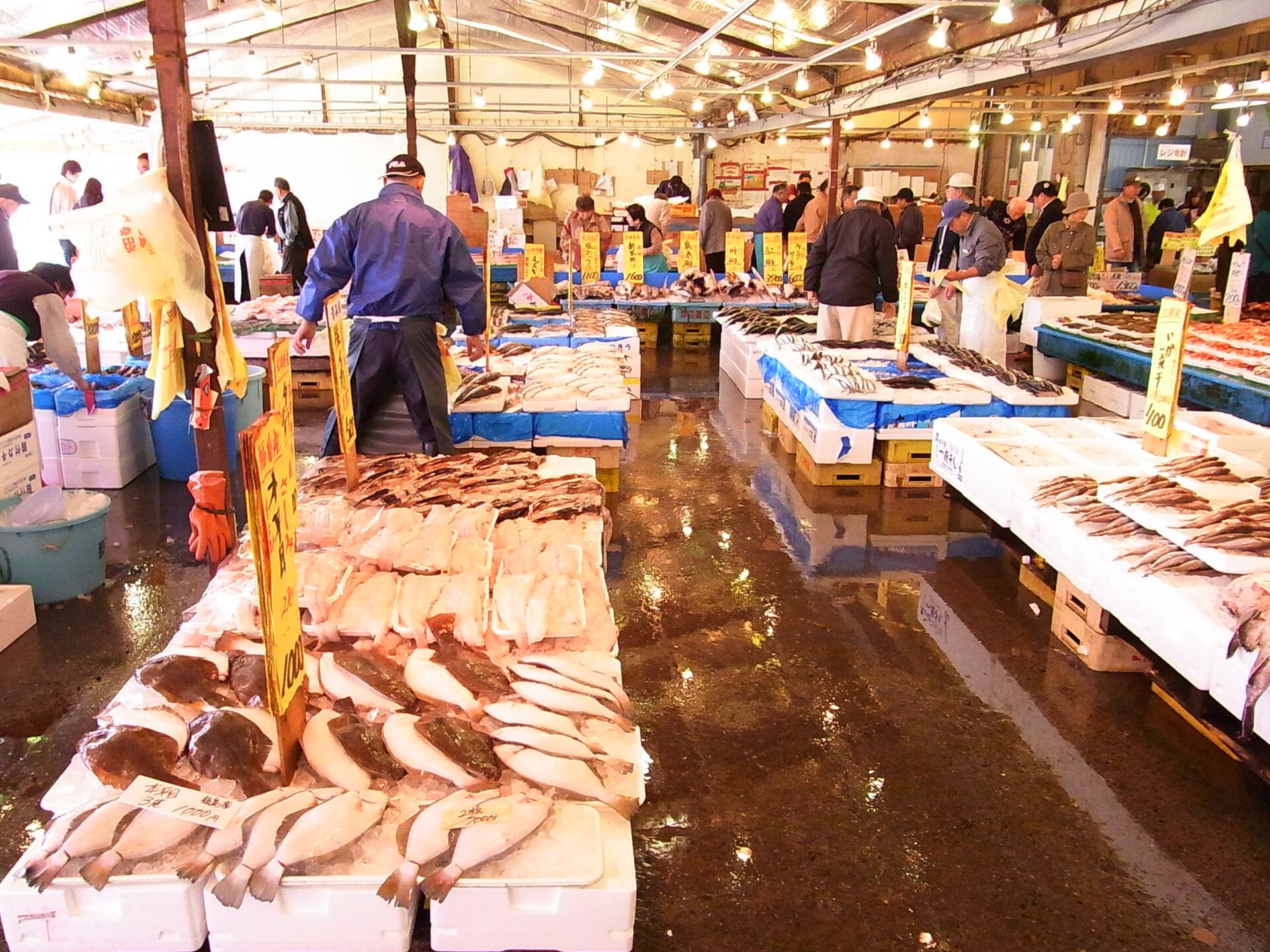
Lunch strategy: The in-house restaurant overlooks the ocean (¥1,000–1,500 set meals) but is mediocre. Better: exit the aquarium, walk 5 min to Oarai Fish Market (see separate entry) for fresh kaisendon.
Combine with: After the aquarium, walk south along the coast to Kamiiso no Torii for sunset through the ocean gate — a perfect thematic pairing (sea creatures inside, sea shrine outside).
Réserver un hébergement à proximité
Trouvez un hébergement près de Oarai Aquarium sur ces plateformes de confiance :
Lieux à proximité
Les lieux secrets les plus proches de Oarai Aquarium, par distance à vol d'oiseau.
 Illustration — il ne s'agit pas d'une photographie
Kamiiso no Torii
Little knownA single vermilion torii gate stands on a jagged rock platform where waves explode into white spray at high tide. Kamiis…
 江戸村のとくぞう (Edomura no Tokuzo) / CC BY-SA 4.0
Nakaminato Fish Market
Little knownNakaminato is a working fishing port on the Ibaraki coast and the market beside it is where the boats' catch is sold dir…
Oarai Fish Market
Little knownOarai Port lands some of the finest Pacific seafood in the Kanto region — flatfish (hirame), Pacific saury (sanma), monk…
 Σ64 / CC BY 3.0
Oarai Beach
Little knownOarai Sun Beach is a 1.5-kilometer crescent of pale sand facing the Pacific, backed by pine groves and bordered by rocky…
 Σ64 / CC BY 3.0
Ajigaura Beach
Little knownAjigaura Beach is a 4-kilometer stretch of sandy coastline facing the open Pacific, known as one of Kanto's best surf br…
 くろふね / CC BY 3.0
Hitachi Seaside Park
Well knownHitachi Seaside Park transforms twice a year into one of Japan's most photographed landscapes. In late April through mid…
Plus de lieux à Préfecture d'Ibaraki
 t.kunikuni / CC BY-SA 2.0
Tsukimachi Falls
Little knownTsukimachi is 17 metres high and 12 metres wide and comes down in three separate strands, and its local name is the fall…
Izura Rokkakudo
Little knownOkakura Tenshin wrote The Book of Tea, ran the Tokyo School of Fine Arts, curated Asian art in Boston, and argued that A…
Makabe Historic District
Locally knownMakabe began as the castle town of the medieval Makabe clan and grew into a market town under the Tokugawa, and the stre…