
Gifu Hidden Gems
Gifu runs from the Nobi plain up into the Hida mountains, and the northern half was cut off by snow for long enough each year to develop its own way of building. The gassho farmhouses at Shirakawa-go have roofs pitched at around sixty degrees to shed the load, with attics used for silkworms and floors laid to let smoke through; they are re-thatched by whole-village work parties because no single household can do it. Takayama, over the pass, was placed under direct shogunate control for its timber and kept a merchant townscape of dark wooden fronts that survives street by street. Further south the Nagara River runs clear enough that cormorant fishing has continued on it for 1,300 years under imperial patronage, and Seki has forged blades since the Kamakura period for the same reason — good water, good clay, good charcoal. The plain around Gifu City is hot, flat and industrial.
40 spots
Climate & Best Season
Hida in the north is cold and snowy; the southern plain is hot and humid. April–May and October–November are ideal.
Famous For (Food)
- Hida beef
- Ayu (sweetfish)
- Keichan
- Gohei-mochi
Signature Sights
- Shirakawa-go (UNESCO)
- Takayama old town
- Gero Onsen
- Gujo Hachiman
When to Go
The two halves need different months. Hida in the north is snow country from December to March, and the Shirakawa-go light-up evenings in January and February are ticketed by lottery. Takayama's spring festival falls on April 14–15 and the autumn one on October 9–10, both of which fill every room in the town. Cormorant fishing on the Nagara runs from mid-May to mid-October, on the river at night. The southern plain is hot and humid in summer, above 34°C, while Takayama at 570 metres stays noticeably cooler. Late October to early November brings colour to the Hida valleys.
Getting Around
Nagoya is the gateway: the JR Takayama line limited express runs from Nagoya to Takayama in about two and a quarter hours, and Gifu City is 20 minutes from Nagoya on the Tokaido line. Chubu Centrair is the nearest airport. Shirakawa-go has no railway — it is a bus from Takayama in about 50 minutes, or from Kanazawa and Toyama on the Hokuriku side — and those buses need reserving in peak season. Gujo Hachiman is on the Nagaragawa Railway from Mino-Ota. Takayama's old town is walkable from its station. For the Hida back roads and Gero's outlying baths, a car is easier, and mountain passes close in winter.
Local Food
Hida beef is raised in the northern mountains and sold in Takayama in every format the old town can think of, including grilled on a skewer to eat while walking. Ayu, sweetfish, is caught in the Nagara through summer and salt-grilled whole; the cormorant fishing exists because of it. Keichan is a Gero and Gujo dish of chicken fried with cabbage in miso or soy on a hot plate. Gohei-mochi is pounded rice pressed onto a flat skewer and grilled with walnut or sesame miso, sold at roadside stops across the Hida and Kiso valleys.
Gujo Odori
Gujo Odori is not a performance. There is no stage and no audience — the dance circles the streets of Gujo Hachiman arou…
Naegi Castle Ruins
Naegi was built on a granite outcrop above the Kiso river, and rather than clear the boulders the builders stacked their…
Tokuyama Dam
Tokuyama holds 660 million cubic metres of water, the largest reservoir capacity of any dam in Japan — roughly twice the…
Iwamura Castle Ruins
Iwamura stands at 717 metres, the highest domain castle in Japan, with 180 metres of vertical between the town and the k…
Tsukechi Gorge
The Tsukechi river runs off the Kiso mountains over a granite bed, and where it cuts through the gorge the water is a gr…
Eihoji
Eihoji was founded in 1313 by Muso Soseki, the monk who designed the gardens at Tenryuji and Saihoji in Kyoto, and it ho…
Kamigare Tea Terraces
Kasuga, in the mountains of western Gifu, has grown tea since the sixteenth century, and at Kamigare the fields climb a…
Kegonji
Kegonji is the thirty-third and final temple of the Saikoku pilgrimage, the oldest pilgrimage route in Japan, and it is…
Mino Udatsu Townscape
An udatsu is a fireproof wall built up above the roofline between neighbouring houses. They were expensive, so having on…
Hirayu Great Falls
Hirayu Otaki drops 64 metres in a single fall on the edge of the Okuhida hot spring villages, one of Japan's hundred wat…
Site of Reversible Destiny Yoro
Arakawa Shusaku and Madeline Gins spent their careers arguing that architecture had made human beings too comfortable an…
Basho Memorial Museum Ogaki
Ogaki is where Oku no Hosomichi ends. Basho arrived here in 1689 after around 2,400 kilometres and five months on the ro…

Mosaic Tile Museum Tajimi
Kasahara in Tajimi makes more mosaic tile than anywhere else in Japan, and in 2016 the town gave itself a museum for it.…

Gifu Sekigahara Battlefield Memorial Museum
On 21 October 1600, around 160,000 men fought in this basin in a single day and the outcome decided who would rule Japan…
Gifu-Kakamigahara Air and Space Museum
Kakamigahara has been Japan's aircraft town since 1917, when the army put its airfield here, and Kawasaki has built aero…
Monet's Pond
A small unnamed pond beside Nemichi Shrine in the Itadori valley, fed by spring water clear enough that the koi appear t…
Masagosoba
Takayama ramen is called chuka soba locally and it is made differently from almost anywhere else: instead of keeping the…
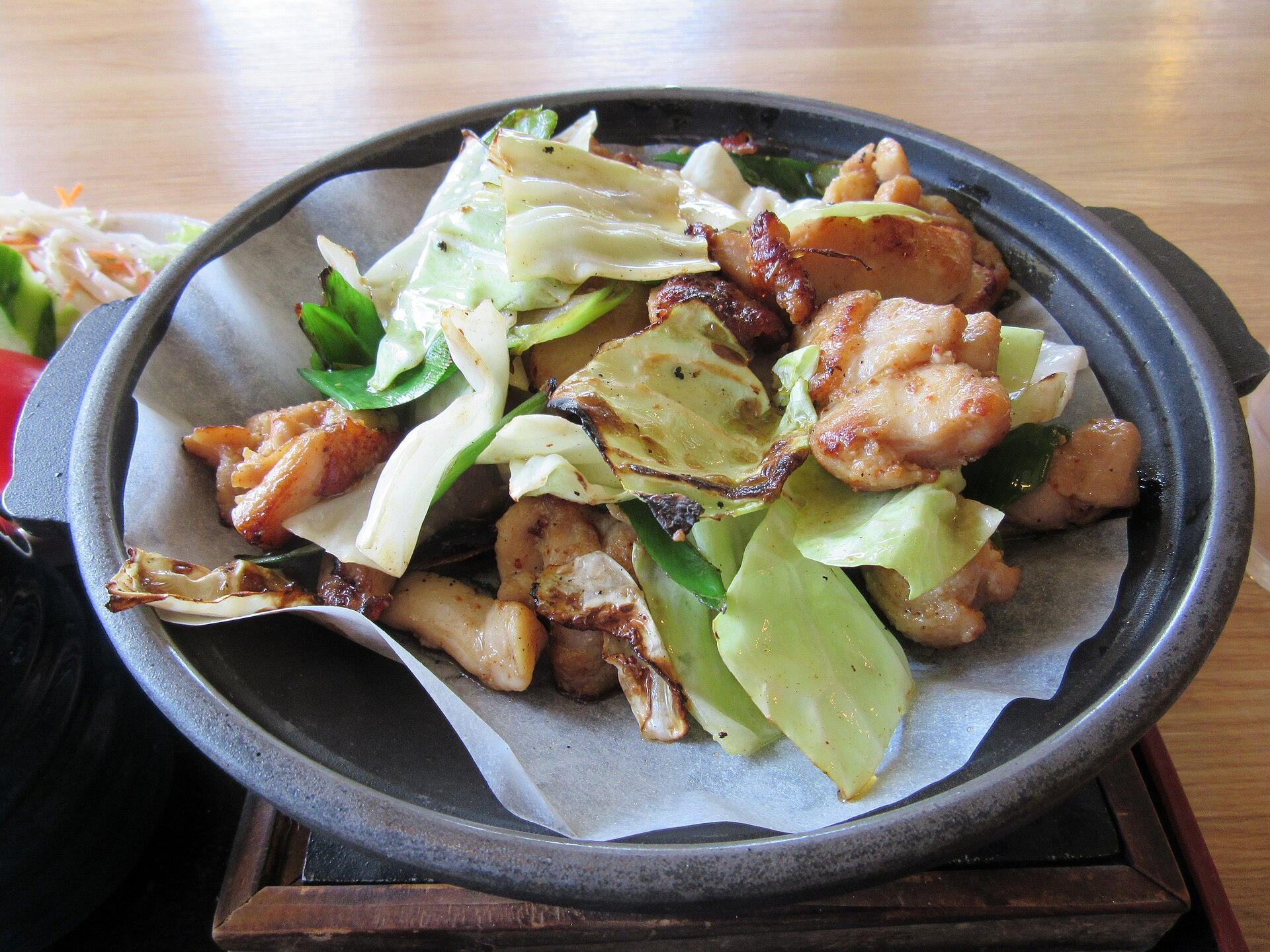
Keichan
Keichan is chicken cut up, marinated in miso and cooked on a hot plate with cabbage. It comes from the Gujo and Gero are…

Nakatsugawa Kurikinton
The kurikinton of Nakatsugawa is not the glossy sweet-potato paste served at New Year elsewhere in Japan. It is chestnut…
Enakyo Gorge Cruise
Enakyo is the reservoir of the Oi dam, completed in 1924 as the first large concrete dam in Japan, which flooded a stret…

Hida Furukawa
Hida Furukawa (飛騨古川) is Takayama's smaller, calmer sibling — a canal-lined town of white-walled storehouses, wooden town…

Gujo Hachiman
Gujo Hachiman (郡上八幡) is a castle town built on spring water — over 100 natural springs flow through the streets in open…
Magome to Tsumago Hike
The Magome-Tsumago hike follows a 7.8km preserved section of the Nakasendo (中山道) — the Edo-period mountain route connect…
 Illustration — not a photograph
Hoba Miso
Hoba miso (朴葉味噌) is Hida's signature dish — a miso-based sauce mixed with green onions, mushrooms, and sometimes Hida be…

Shirakawa-go Gassho-zukuri Village
Shirakawa-go (白川郷) clusters 114 gassho-zukuri (合掌造り, 'praying hands') farmhouses in a mountain valley where snow piles 3…
Gokayama Ainokura
Gokayama's Ainokura (相倉集落) is Shirakawa-go's smaller, quieter neighbor — a hamlet of 20 gassho-zukuri farmhouses set on…
 Illustration — not a photograph
Seki Knife Forging
Seki (関市) has been Japan's blade-forging center for 800 years, originally producing samurai swords and now crafting some…
Takayama Sanmachi Old Town
Takayama's Sanmachi Suji (三町筋) is one of Japan's most perfectly preserved Edo-period merchant quarters — three parallel…

Takayama Morning Markets
Takayama operates two daily morning markets (朝市, asaichi) — Miyagawa Market along the Miyagawa River (60+ stalls) and Ji…

Gero Onsen
Gero Onsen (下呂温泉) is ranked among Japan's 'Three Great Hot Springs' (alongside Kusatsu and Arima) for its exceptionally…
Takayama Jinya
Takayama Jinya (高山陣屋) is the only surviving Edo-period provincial government office (jinya) in Japan, where Tokugawa sho…
Hida Folk Village (Hida no Sato)
Hida no Sato (飛騨の里) is an open-air museum preserving over 30 traditional farmhouses relocated from across the Hida regio…
Gero Onsen Gassho Village
Gero Onsen Gassho Village (合掌の里) combines two of Gifu's signatures — alkaline hot springs and UNESCO-style gassho-zukuri…

Gifu Castle
Gifu Castle (岐阜城) crowns Mt. Kinka (329m), a dramatic mountain rising from the Nagara River plain. The castle's current…
Mino Washi
Mino washi (美濃和紙) is handmade paper produced in Mino City using techniques designated UNESCO Intangible Cultural Heritag…
Gujo Hachiman Food Sample Workshops
Gujo Hachiman produces 60% of Japan's sampuru (food samples) — the hyper-realistic plastic replicas displayed in restaur…
Nagara River Cormorant Fishing (Ukai)
Ukai (鵜飼, cormorant fishing) happens after dark on the Nagara River between May 11 and October 15. Fishermen in traditio…
Shinhotaka Ropeway
The Shinhotaka Ropeway (新穂高ロープウェイ) is Japan's only double-decker cable car, ascending 1,308 meters from the Hida mountai…
Hida Beef
Hida beef (飛騨牛, Hida-gyu) comes from Japanese Black cattle raised in Gifu for at least 14 months, graded A5 or B5 for ma…

Takayama Festival Floats
Takayama Matsuri (spring April 14–15, autumn October 9–10) is ranked among Japan's three most beautiful festivals for it…