
Yamanashi
20 places listed. 16 of them are places general guidebooks skip.
Yamanashi is a basin with no coastline and mountains on every horizon, and the two facts that matter most both come from that. First, the enclosed valley gets long hours of sun, low rainfall and a wide gap between day and night temperatures, which is exactly what fruit wants — the prefecture grows more grapes and peaches than any other, and the Katsunuma district has been making wine since the 1870s using Koshu, a pink-skinned grape that reached Japan along the Silk Road centuries earlier. Second, Mt. Fuji sits on the southern border, and the Fuji Five Lakes are dammed lava flows at its foot, which is why the views from Kawaguchiko and the Chureito pagoda place the mountain across water or over rooftops rather than at the end of a trail. Kofu, in the middle, was the Takeda clan's base, and the local castle was never a grand keep because Takeda Shingen preferred a fortified residence.
20 spots
Beaucoup de soleil, peu de pluie, des nuits fraîches : ce qu'aime le fruit
Ringed by mountains and with no coast at all, this basin gets long hours of sunshine, relatively little rain, and a wide gap between daytime and night-time temperatures. That combination is close to ideal for fruit, which is why the prefecture leads the country in grapes and peaches and why commercial winemaking started here in the 1870s, working with a pale pink-skinned grape that had reached Japan overland centuries before.
The wine is worth taking seriously rather than as a novelty; the local white is dry, light and food-friendly, and dozens of small producers pour it. The obvious problem is that tasting and driving are incompatible, and the wineries are spread through farmland. The workable answer is the cluster within walking distance of the vineyard-district station, which exists for exactly this reason — arrive by train, walk between four or five, and take the express back.
Combien de jours faut-il ?
Two days, and the honest framing is that Yamanashi is a mountain view and a wine region rather than a place with a centre. Kofu, the capital, is about ninety minutes from Shinjuku by limited express and is a base rather than a sight.
The two routes. North: the Fuji Five Lakes, roughly two hours from Tokyo by bus, which is where the postcard view of the mountain from across a lake comes from and where most visitors go. East and central: the Katsunuma vineyards and the Shosenkyo gorge, both within forty minutes of Kofu, which is a completely different and much quieter day.
One night at the lakes plus one in Kofu covers it. If the mountain is the whole reason for the trip, note that it is visible on far fewer days than photographs suggest, and that clear winter mornings are the reliable window rather than summer afternoons.
Les lacs au pied du mont ont été formés par le mont lui-même
The chain of lakes on the southern border is not a set of natural valleys that happen to sit below a volcano. They are what remained when lava flows blocked the drainage of the land at its foot, which is why they lie in a rough arc at a similar altitude and why the shore in several places is black rock and pine rather than sand.
This is the reason the famous views look the way they do. The mountain is seen across water or over a town from close range, on the flat, rather than from a ridge at a distance — you are standing on its own debris. It also explains the lava caves and the wind cave in the forest nearby, and the forest itself, which grew back on the flows and is shallow-rooted and disorienting as a result. Walk one of the lava tubes if you have an hour; it makes the landscape legible in a way the photographs do not.
Se déplacer
The JR Chuo line limited express reaches Kofu from Shinjuku in about 90 minutes, and the Fujikyu line branches at Otsuki for Kawaguchiko; direct trains and highway buses also run from Shinjuku to Kawaguchiko in around two hours. Highway buses are often the faster option for the Fuji side. Once there, the Kawaguchiko sightseeing buses circle the lakes, but the further lakes and the Chureito pagoda area reward a car, as do the Katsunuma wineries — which is the standard problem, since tasting and driving do not mix. Several wineries sit within walking distance of Katsunuma-Budokyo Station for that reason.
Quand ne pas y aller
Summer afternoons if you have come for the mountain. Haze builds through the day and through the season, and July and August are the worst months for actually seeing Fuji despite being the only months you can climb it. The reliable view is a clear morning between November and February, which is the opposite of when most visitors arrive.
Avoid the climbing season's opening and closing weekends if you intend to climb, when the route is at its most congested. And note that the trails are officially open only for a short summer window and closed the rest of the year regardless of the weather — an out-of-season attempt is not a bold choice but an unsupported one, with the huts shut and no help on the mountain.
Quand y aller
Fuji shows itself far more often in winter than in summer: cold, dry mornings from December to February give the clearest views, though the lakes are cold and some boat services thin out. The climbing season on the mountain itself is only early July to early September, and huts and trails are busy throughout. Grapes ripen from August to October and peaches through July and August, with pick-your-own orchards around Katsunuma and Fuefuki. The basin is hot in summer, above 33°C, and cold and dry in winter with little snow. Shosenkyo gorge colours in early November, and the Fuji Shibazakura festival runs mid-April to late May.
Climat et meilleure saison
Enclavé et sec : étés chauds, hivers froids et dégagés avec peu de neige dans le bassin. Les matinées d'hiver offrent les vues les plus nettes du Fuji.
Spécialités culinaires
- Nouilles hoto
- Raisins et pêches
- Vin koshu
- Torimotsu-ni
Lieux emblématiques
- Cinq Lacs du Fuji
- Pagode de Chureito
- Gorges de Shosenkyo
- Domaines viticoles de Katsunuma
Cuisine locale
Hoto is flat wheat noodles simmered in miso broth with pumpkin and root vegetables, thick enough to be eaten with a spoon, and it is a winter dish that Takeda-era soldiers are said to have carried the ingredients for. The Koshu grape makes a dry, light white that has gone in and out of international fashion; Katsunuma has dozens of small wineries pouring it. Peaches and grapes are sold from roadside stands from July to October. Torimotsu-ni, chicken offal glazed in a sweet soy reduction, is a Kofu speciality that started in a soba shop.
Voiture ou train ?
Trains and buses are enough. The express from Shinjuku runs to Kofu and Otsuki, the private line and the direct buses serve the Five Lakes, and the wine town of Katsunuma has its own station on the main line with wineries walkable from it — which is a genuinely unusual and useful arrangement for a wine region.
A car helps for the higher valleys, the Minami Alps foothills and the smaller vineyards. It is a liability at the lakes in peak season, when the road around Kawaguchiko is congested and parking near the good viewpoints fills early. If you are climbing Fuji itself in the summer season, the bus to the fifth station is the intended approach and private vehicles are restricted at busy times.
Première visite ou retour
A first visit goes to the lakes and should be built around a morning rather than a day. Get up early, look at the mountain while the air is clear, and treat everything after ten as a bonus — the pattern of visitors arriving at midday and seeing cloud is so consistent it is almost a rule.
A second visit should ignore Fuji entirely and go to the wine. Katsunuma has been growing grapes since the nineteenth century, the local koshu variety exists essentially nowhere else, and the wineries are small, welcoming and reachable on foot from a train station on the Tokyo line. Add the Shosenkyo gorge in late October and you have a weekend that is genuinely about Yamanashi rather than about the mountain that happens to sit on its border.
Où aller, selon le temps que cela demande
Short stops around Kofu and the lakes
4 sites
An hour or less: a winery tasting room, a shrine, a lakeside viewpoint, a museum in the capital. Around Katsunuma several of these are walkable from the station, which makes an afternoon of short stops genuinely easy and is the best-kept secret in the prefecture. At the lakes they are what you do after the morning's clear view has gone — which, given how the weather works here, is most days by about ten o'clock. Treat them as the plan rather than the consolation and the day works much better.
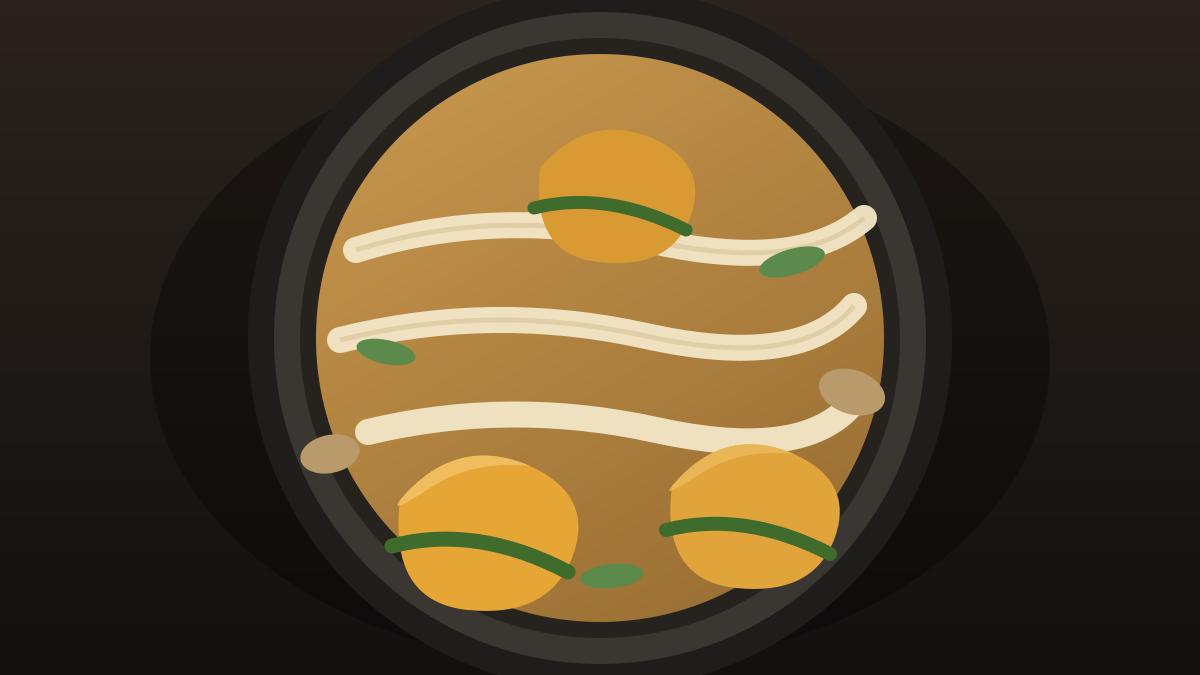 Illustration — il ne s'agit pas d'une photographie
Hoto Noodles
An hour or less on site, reachable on public transport. A few thousand yen. Open all year, at its best in spring, autumn and winter.
Momiji Kairo Maple Corridor
An hour or less on site, reachable on public transport. Free to enter. Autumn and winter is the season for it.
Daizenji Taisekiji Temple
An hour or less on site, reachable on public transport. Under ¥1,000. Spring and autumn is the season for it.
Aokigahara Forest
An hour or less on site, reachable on public transport. Under ¥1,000. Open all year, at its best in summer and winter.
Half days from Kofu or Kawaguchiko
10 sites
Three or four hours each on scheduled transport: the lakeside viewpoints and ropeway, the gorge, the larger wineries and the museums. The bus network around the Five Lakes is frequent and built for visitors, and the main line through Kofu and Katsunuma is fast enough that several of these work as day trips from Tokyo. In peak season the roads around the lakes congest badly, so the bus is the faster option rather than the compromise. If the mountain is the reason you came, front-load this band into the morning and leave the indoor options for the afternoon haze.
 Illustration — il ne s'agit pas d'une photographie
Lake Yamanakako
Half a day on site, reachable on public transport. A few thousand yen. Summer, autumn and winter is the season for it.
Shosenkyo Gorge
Half a day on site, reachable on public transport. A few thousand yen. Spring, summer and autumn is the season for it.
Kofu Wine Wineries
Half a day on site, reachable on public transport. Free to enter. Open all year, at its best in summer and autumn.
Takeda Shingen Historical Sites
Half a day on site, reachable on public transport. Under ¥1,000. Spring is the season for it.
Isawa Onsen
Half a day on site, reachable on public transport. Under ¥1,000. Spring, summer and autumn is the season for it.
Oshino Hakkai
Half a day on site, reachable on public transport. Under ¥1,000. Open all year, at its best in autumn.
Kawaguchiko Music Forest Museum
Half a day on site, reachable on public transport. A few thousand yen. Summer and autumn is the season for it.
Lake Saiko Bat Cave and Forest
Half a day on site, reachable on public transport. Under ¥1,000. Spring, autumn and winter is the season for it.
Maizuru Castle Park
Half a day on site, reachable on public transport. Under ¥1,000. Spring and winter is the season for it.
Erin-ji Temple
Half a day on site, reachable on public transport. Under ¥1,000. Open all year, at its best in spring and autumn.
The high valleys and the mountain itself
6 sites
Fuji's climbing route in its short summer window, the Minami Alps foothills, the higher valleys and the smaller vineyards spread across them. These take the whole day and most want a car, with the notable exception of the mountain, where the bus to the fifth station is the intended approach and private vehicles are restricted at busy times. Outside the official climbing season the trails are closed, the huts are shut, and that closure is not advisory. For everything else in this band, late spring and October are the usable windows, since the higher roads carry snow well past the point at which the valleys look ready.
 Illustration — il ne s'agit pas d'une photographie
Yamanashi Fruit Picking
Half a day on site, easier with a car. Under ¥1,000. Summer and autumn is the season for it.
Lake Shojiko and Lake Motosuko
Half a day on site, easier with a car. Under ¥1,000. Spring, autumn and winter is the season for it.
Kitaguchi Hongu Fuji Sengen Shrine
An hour or less on site, reachable on public transport. Open all year, at its best in summer and autumn. Within two hours of Kofu Station.
Chureito Pagoda
Half a day on site, reachable on public transport. Free to enter. Spring and autumn is the season for it. Within two hours of Kofu Station.
Lake Kawaguchiko
A full day on site, reachable on public transport. Free to enter. Spring, autumn and winter is the season for it. Within two hours of Kofu Station.
 Illustration — il ne s'agit pas d'une photographie
Mt. Fuji Yoshida Trail
A full day on site, reachable on public transport. A few thousand yen. Summer and autumn is the season for it. Within two hours of Kofu Station.