
Shimane Hidden Gems
Shimane keeps the oldest strand of Japanese religion, and it does so in a place that modern Japan largely bypassed. Izumo Taisha appears in the eighth-century chronicles as a rival centre to the imperial cult, and its main hall is built in a style older than Buddhist architecture in Japan, with a shimenawa rope at the front hall weighing several tonnes. The clapping here is four times rather than the usual two. In the tenth lunar month, when the rest of the country calls it the month without gods, Izumo calls it the month with gods, because they are said to gather here. West along the coast, Iwami Ginzan was one of the great silver mines of the sixteenth century and supplied a significant share of world production; what remains is a wooded valley of tunnels and a preserved mining town rather than an industrial site. Matsue, on the lagoon, kept its castle and the writer Lafcadio Hearn.
34 spots
Climate & Best Season
Mild but wet, with grey winters and moderate snow inland. Best in spring, autumn, and during Kamiarizuki in November.
Famous For (Food)
- Izumo soba
- Shijimi clams
- Nodoguro
- Wari-go soba
Signature Sights
- Izumo Taisha
- Matsue Castle
- Iwami Ginzan (UNESCO)
- Adachi Museum garden
When to Go
The San'in coast is wet and grey through winter, with steady rain rather than deep snow near the sea and January highs around 9°C; the inland hills do get snow. Kamiarizuki, the divine gathering at Izumo, falls in the tenth lunar month, which lands in November, and the shrine's rites through that week are the main annual event. Summers are humid and hot in the low 30s°C. The Adachi Museum's garden is composed to be seen through windows and is deliberately good in all four seasons, snow included. Spring and autumn are the easiest for the Iwami Ginzan walking routes.
Getting Around
There is no shinkansen on this coast. The usual approach is the Sanyo Shinkansen to Okayama and then the Yakumo limited express north to Matsue, about two and a half hours, or a flight into Izumo Airport, roughly an hour and a half from Haneda. The overnight Sunrise Izumo sleeper runs from Tokyo and is a genuine option. Locally the JR San'in line links Matsue, Izumo and the west, but it is slow and infrequent; the private Ichibata line also runs from Matsue to Izumo Taisha. Iwami Ginzan needs a bus from Odashi Station and is then walked or cycled. A car is the sensible choice for anything off the coastal line.
Local Food
Izumo soba is served cold in stacked round lacquer dishes called wari-go, with the sauce poured over the noodles rather than the noodles dipped, and the buckwheat is milled with the husk so it comes out dark. Lake Shinji supplies shijimi, small brackish-water clams, in a miso soup that Matsue drinks at breakfast. Nodoguro, the fatty rockfish of the San'in coast, is grilled and is the local luxury. Matsue was a tea town under its last daimyo, so wagashi shops there are unusually good and pair with matcha in the castle-side teahouses.
Iwami Tatamigaura
In 1872 the Hamada earthquake lifted a section of sea floor about a metre out of the water, and it has stayed there. The…
Ura-Hikimi Gorge
Hikimi is the mountainous inland part of Masuda, up against the Hiroshima border, and the gorge system there splits into…
Shussai Kiln
Shussai Kiln was started in 1947 by five local men in their twenties, none of them trained potters, who decided to make…
Oni no Shitaburui
The name means the demon's tongue trembling, and it comes from a story in the Izumo Fudoki about a shark deity in love w…
Tachikue Gorge
Twenty minutes from central Izumo, the Kando River runs between walls of columnar rock rising 100 to 200 metres — eroded…
Kiyomizu-dera (Yasugi)
Not the Kyoto one. This Kiyomizu-dera is a mountain temple complex above Yasugi, founded in 587 according to its own acc…
Karakama Shrine
Karakama Shrine is reached by squeezing through a gap in a rock. The approach climbs a steep flight of stone steps into…
Gassantoda Castle
Gassantoda was the seat of the Amago, one of the great warlord houses of western Japan, and it is generally counted amon…

Yunotsu Onsen
Yunotsu was the port that shipped silver out of Iwami Ginzan, and when the mine was inscribed by UNESCO the town went in…
Arifuku Onsen
Arifuku is a hot spring village folded into a narrow valley in Gotsu, with inns stacked up the slope on either side of a…
Sugaya Tatara Sannai
Tatara is the Japanese smelting method that produced tamahagane, the steel used for swords — iron sand and charcoal fed…
Sanbe Azukihara Buried Forest
About four thousand years ago Mt. Sanbe erupted and buried the forest at its foot in volcanic debris — not flattening th…
Iwami Kagura at Sannomiya Shrine
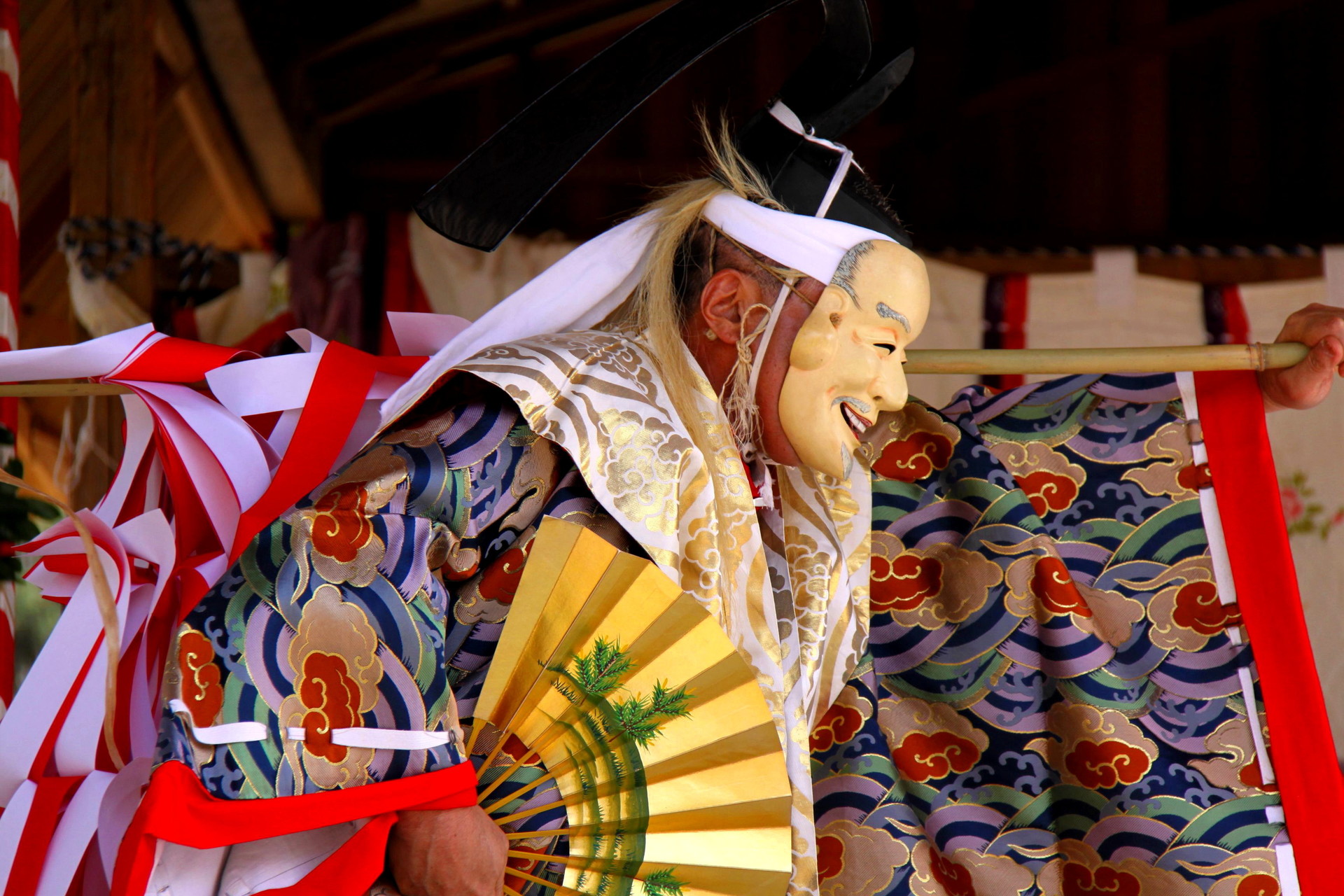
Iwami kagura is the loud one. Where much shrine dance in Japan is slow and hieratic, the western Shimane version is fast…
Kamosu Shrine
Everyone goes to Izumo Taisha for the architecture. The oldest surviving example of that architecture is here instead, i…
Yaegaki Shrine
Yaegaki enshrines Susanoo and Kushinada — the god who killed the eight-headed serpent Yamata-no-Orochi and the woman he…
Kumano Taisha (Izumo)
Shimane has two shrines that claim the rank of first shrine of Izumo province. Everyone knows the one at Izumo Taisha; t…
Ryuzugataki Falls
Ryuzugataki is two waterfalls: the female fall at 30 metres and the male fall at 40, the larger of which is described as…
Ikoji Temple
Sesshu is the most important ink painter Japan produced, and he spent part of his later life in Masuda, at the western e…
Yakumoan
Yakumoan occupies a converted samurai residence on Shiomi Nawate, the street of preserved warrior houses running along t…
Arakiya
There are a dozen soba shops around Izumo Taisha and Arakiya is the oldest of them, founded in the Tenmei era of the 178…
Oki Islands
Oki Islands (隠岐諸島) are a remote archipelago in the Sea of Japan, 40–80km north of mainland Shimane. The islands form a U…
Izumo Taisha
Izumo Taisha is one of Japan's oldest shrines, maybe the oldest depending on who's counting. It's dedicated to Okuninush…
Tsuwano
Tsuwano (津和野) is a preserved castle town nicknamed 'Little Kyoto of San'in' for its traditional architecture, samurai di…
Hinomisaki Shrine & Lighthouse
Hinomisaki (日御碕) is a dramatic cape at Shimane's western tip featuring Hinomisaki Shrine (vermillion shrine buildings) a…
Tamatsukuri Onsen
Tamatsukuri Onsen (玉造温泉) is a 1,300-year-old hot spring resort famous for beautifying waters rich in sulfate and chlorid…
Adachi Museum of Art
Adachi Museum of Art has been ranked the #1 Japanese garden in Japan by the Journal of Japanese Gardening for over 20 co…
Yuushien Garden
Yuushien Garden (由志園) is a Japanese stroll garden on Daikonshima Island featuring 10,000+ peony flowers in a 40,000 m² l…
Lake Shinji Sunset
Lake Shinji (宍道湖) is Japan's seventh-largest lake, famous for its spectacular sunsets ranked among the nation's top 100.…
Iwami Ginzan
Iwami Ginzan is the remains of Japan's biggest silver mine, which from 1526 to 1923 pulled enough silver out of these mo…

Matsue Castle
Matsue Castle (松江城) is one of Japan's 12 surviving original castles, built in 1611 and never destroyed by war or fire. T…
Matsue Wagashi Sweets
Matsue is ranked among Japan's top wagashi (和菓子, traditional Japanese sweets) cities, with per-capita wagashi consumptio…
Lafcadio Hearn Residence
Lafcadio Hearn (小泉八雲, Koizumi Yakumo, 1850–1904) was a Greek-Irish writer who moved to Japan in 1890, married a samurai'…
 Illustration — not a photograph
Izumo Soba
Izumo Soba (出雲そば) is Shimane's signature noodle dish, served in a unique warigo (割子) style: three small stacked lacquere…
Horikawa Moat Boat Ride
Horikawa Sightseeing Boat (堀川めぐり) navigates the 3.7km moat surrounding Matsue Castle, passing under 16 bridges (some ext…