
Nara
Nara was Japan's first permanent capital, from 710, and it was abandoned as a capital after seventy-four years — which turns out to be why so much of it survived. The court moved on, the great temples stayed, and because the city never became a major commercial centre it was never rebuilt over or, later, bombed. Todaiji's main hall is a reconstruction at two-thirds of its original width and is still one of the largest wooden buildings in the world; Horyuji, a short train ride southwest, has structures generally accepted as the oldest surviving timber buildings anywhere. The deer in the park are not decorative — they were protected for centuries as messengers of the Kasuga deity, killing one was a capital offence, and there are well over a thousand of them working the crowds today. South of the city the land rises into the Yoshino mountains, which have been planted with cherry trees as religious offerings since the Heian period.
20 spots
Elle ne fut capitale que soixante-quatorze ans, et c'est pourquoi elle a survécu
The court established its first permanent capital here and then moved away again within a lifetime. The great temples stayed. Because the city never went on to become a major commercial or military centre, it was never comprehensively rebuilt over, and it was not bombed in the twentieth century — so what stands includes timber structures generally accepted as the oldest surviving anywhere in the world.
That is the frame worth carrying around the park: you are not looking at old buildings in an old city, you are looking at what was left when the political weight moved on. It also explains the scale. The main hall of the great temple is a reconstruction at roughly two-thirds of the original width and is still enormous, which tells you something about what the eighth-century court was willing to spend on a capital it then walked away from.
Combien de jours faut-il ?
One day for the park, two for the prefecture, and the gap between those two numbers is where all of Nara's interest lies. The city park with the deer, the great bronze buddha and the shrine on the hillside is genuinely a single day, and it is forty-five minutes from Osaka and an hour from Kyoto, so most visitors do exactly that and leave.
The second day should go to Asuka or Yoshino. Asuka, thirty to forty minutes south by private railway, is where the Japanese state was assembled in the sixth and seventh centuries, and it is now farmland with burial mounds and stone figures in it, best seen by rented bicycle. Yoshino, about ninety minutes south, is a mountain ridge of cherry trees and a pilgrimage centre.
Three days lets you reach the Kii mountains and the pilgrimage routes, which are a serious commitment and mostly belong to Wakayama.
Se déplacer
Kintetsu-Nara Station is closer to the park and Todaiji than JR Nara, and Kintetsu limited expresses reach it in about 35 minutes from Osaka-Namba and 35 from Kyoto — so day-tripping from either city is straightforward. The main sights, from Kofukuji through Todaiji to Kasuga Taisha, are a single walk of a couple of kilometres. Horyuji is on the JR Yamatoji line with a short bus at the end. Yoshino is the long one: about an hour and a half from Osaka by Kintetsu, then a ropeway or a climb. The Asuka countryside is best by rental bicycle from Asuka Station. Buses into the southern mountains are sparse.
Les cerfs sont des animaux sauvages protégés comme messagers divins
The animals in the park were regarded as messengers of the shrine deity and were protected for centuries under penalties that were, at various points, extremely severe. There are well over a thousand of them and they are not tame, kept or fed by anyone — they are wild animals that have learned that people carry food.
Behave accordingly and everyone has a better time. Buy the official crackers if you want to feed them, hold nothing back once they know you have some, and do not tease: they will push, and stags in the autumn rut are genuinely dangerous and are dealt with by having their antlers cut for exactly that reason. Keep paper maps and tickets out of reach, because they will be eaten. And go at first light if you can — the park before the coaches arrive, with mist on the pond, is the version worth the journey.
Quand ne pas y aller
Yoshino during the cherry blossom, unless that is precisely the plan and it has been booked. Thousands of trees up a mountainside in sequence is one of the great sights in Japan and the small town at the top is overwhelmed for the two weeks it lasts.
Nara Park in the middle of the day, any day, is the other thing to avoid. The deer, the crowds and the coach parties concentrate between ten and three; the same park at seven in the morning, with mist on the pond and the deer moving between the trees, is a different place entirely. Summer is hot and the park has little shade.
Climat et meilleure saison
Cuvette chaude et humide en été, froide en hiver ; les monts Yoshino sont plus frais et enneigés. Cerisiers en avril, feuillage en novembre.
Spécialités culinaires
- Kakinoha-zushi
- Miwa somen
- Légumes marinés narazuke
- Douceurs au kudzu
Lieux emblématiques
- Todaiji et parc de Nara
- Kasuga Taisha
- Horyuji (UNESCO)
- Cerisiers du mont Yoshino
Quand y aller
Yoshino's cherries open in waves up the mountainside from the lower to the upper slopes across roughly two weeks in April, later than the city below. Nara Park's autumn colour peaks in mid to late November. The basin is hot and closed-in during summer, above 34°C in August, and cold in winter with January highs near 9°C — Yoshino gets snow. Two set-piece events are worth timing for: Omizutori at Todaiji, a fire rite running through the first two weeks of March, and the lantern lightings at Kasuga Taisha in early February and mid-August. Early morning in the park is when the deer are calmest.
Cuisine locale
Kakinoha-zushi is salted mackerel on rice wrapped in a persimmon leaf, invented in the mountains as a way of getting sea fish inland before refrigeration, and it is still the local packed lunch. Miwa, southeast of the city, claims the oldest somen tradition in Japan and hand-stretches the noodles in winter. Narazuke are vegetables pickled repeatedly in sake lees until they turn amber and taste faintly alcoholic. Yoshino makes kudzu into a thin, clear starch used for hot puddings and dumplings, best eaten in the mountain town where it is refined.
Voiture ou train ?
The private railway from Osaka and Kyoto reaches Nara, Asuka and Yoshino frequently and is faster than JR for all three. Nara's park is a walk from the station; Asuka is best on a rented bicycle from its own small station; Yoshino has a cable car up the ridge.
A car is worth it for the mountainous south — the Kii peninsula's interior, Totsukawa, the pilgrimage trailheads — where buses run a few times a day and distances are long. That is a genuinely remote part of Japan an hour and a half from Osaka, which is the most surprising fact about this prefecture.
Première visite ou retour
A first visit should stay overnight rather than day-tripping from Kyoto, and the reason is the morning. Todai-ji opens early, the park is empty before the coaches arrive, and the walk up to Kasuga's stone lanterns through the forest at that hour is the best hour in the city. Nearly every visitor comes at eleven and leaves at four, which is the worst possible window.
A second visit is Asuka by bicycle. Burial mounds, carved stone figures nobody can fully explain, temples that predate the capital at Nara itself, and a landscape of rice fields and low hills you ride between. It is where the country began and it is almost entirely undeveloped, which is a very strange and good thing to encounter forty minutes from Osaka.
Où aller, selon le temps que cela demande
Short stops in and around the park
6 sites
An hour or less, nearly all within walking distance of Nara Park or its station: halls, shrines, museums, the old merchant quarter south of the centre. Nara is compact enough that a day of short stops on foot is the natural way to visit, and the decisive variable is the hour rather than the itinerary — the same walk at seven in the morning and at noon are two different experiences. Start early and use the middle of the day for something indoors.
Asuka-dera Temple
An hour or less on site, reachable on public transport. Under ¥1,000. Open all year, at its best in spring.
Nara Sake
An hour or less on site, reachable on public transport. Autumn and winter is the season for it.
Nara-machi Koshi-no-ie
An hour or less on site, reachable on public transport. Free to enter. Open all year.
Ukimido Pavilion
An hour or less on site, reachable on public transport. Free to enter. Open all year, at its best in spring and autumn.
 Illustration — il ne s'agit pas d'une photographie
Gangoji Temple
An hour or less on site, reachable on public transport. Under ¥1,000. Open all year, at its best in spring and autumn.
Kasuga Taisha
An hour or less on site, reachable on public transport. Spring, summer and winter is the season for it.
Half days on the private line
12 sites
Three or four hours each: the great temple complexes, the shrine on the hillside, Horyu-ji out to the west, Asuka's bicycle routes to the south. The private railway from Osaka and Kyoto makes all of this easy and is faster than JR, which surprises people holding a rail pass. Asuka in particular is best given a proper half-day with a rented bicycle rather than an hour on foot, since the sites are spread across farmland rather than clustered in a town.
Kashihara Jingu Shrine
Half a day on site, reachable on public transport. Spring, autumn and winter is the season for it.
Wakakusayama Hill
Half a day on site, reachable on public transport. Under ¥1,000. Spring, autumn and winter is the season for it.
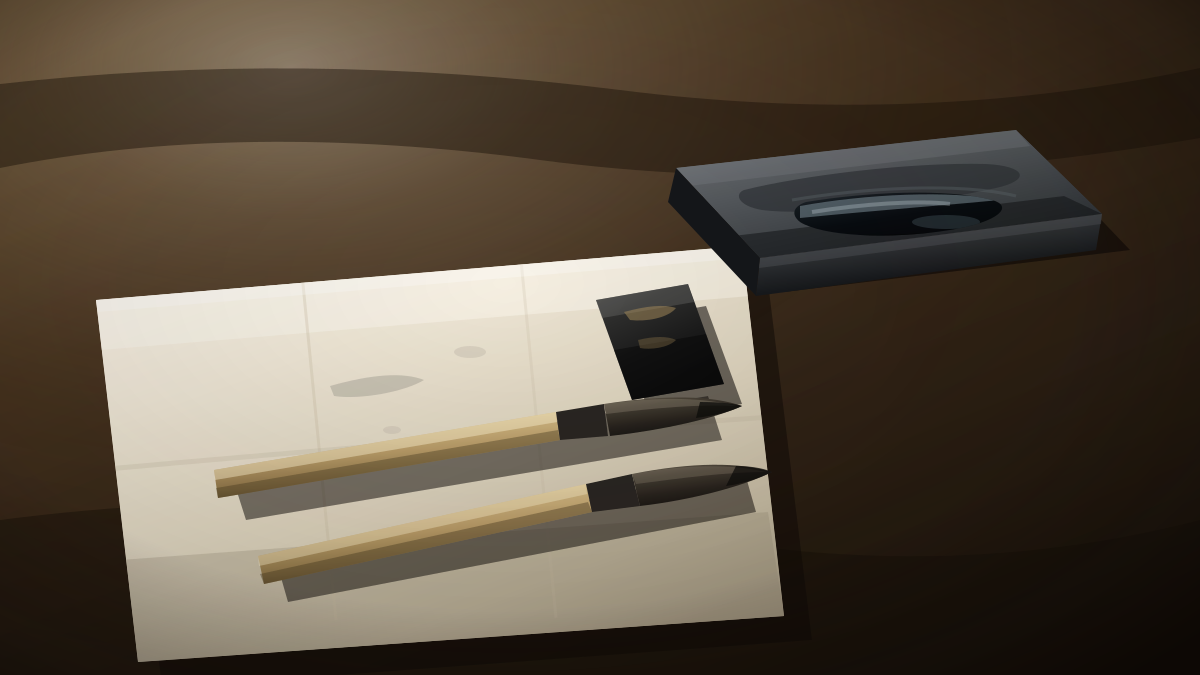 Illustration — il ne s'agit pas d'une photographie
Nara Sumi Ink & Fude Brushes
Half a day on site. Open all year.
Nara National Museum
Half a day on site, reachable on public transport. Under ¥1,000. Autumn is the season for it.
 Illustration — il ne s'agit pas d'une photographie
Nara Hotel
Half a day on site, reachable on public transport. A few thousand yen. Open all year, at its best in spring, autumn and winter. Within an hour of Nara Station.
Kofukuji Temple
Half a day on site, reachable on public transport. Open all year, at its best in spring and autumn.
Horyuji Temple
Half a day on site, reachable on public transport. A few thousand yen. Open all year, at its best in spring and autumn.
Yakushiji Temple
Half a day on site, reachable on public transport. A few thousand yen. Open all year, at its best in spring and autumn.
Toshodaiji Temple
Half a day on site, reachable on public transport. Under ¥1,000. Open all year, at its best in spring, summer and autumn. Within half an hour of Nara Station.
Heijo Palace Site
Half a day on site, reachable on public transport. Open all year, at its best in spring and autumn.
Nara Park
Half a day on site, reachable on public transport. Free to enter. Open all year, at its best in spring, summer and autumn. Within an hour of Nara Station.
Naramachi
Half a day on site, reachable on public transport. Open all year, at its best in spring and autumn.
Yoshino and the Kii mountains
2 sites
The full-day half: the cherry ridge and pilgrimage centre at Yoshino, and beyond it the mountainous interior of the Kii peninsula with its pilgrimage trails, gorges and villages. This is remote country an hour and a half from Osaka, with buses running a few times a day and long distances between anything. A car changes it from a logistical exercise into a drive. In blossom season Yoshino is extraordinary and completely booked, so decide months rather than days ahead. Outside those two weeks the same ridge is quiet, and the walking on it is better without the crowd.
 Illustration — il ne s'agit pas d'une photographie
Asuka Village
A full day on site, reachable on public transport. Under ¥1,000. Spring, summer and autumn is the season for it. Within an hour of Nara Station.
Todaiji Temple
Half a day on site, reachable on public transport. Under ¥1,000. Open all year, at its best in spring and autumn. Within two hours of Nara Station.