
Kinkaku-ji
Recherche et rédaction Hinato
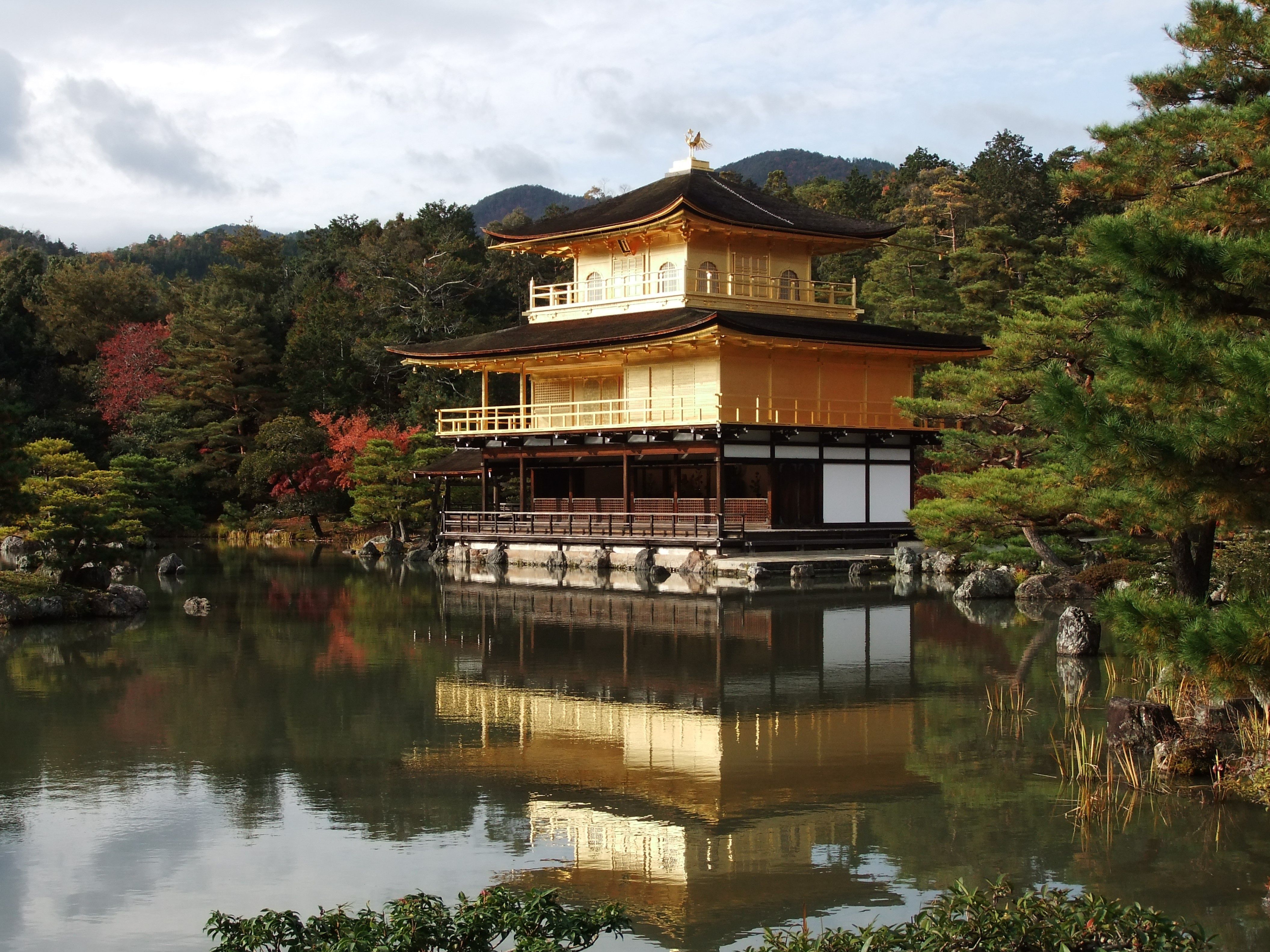
Photo: Pexels (Pexels License) · original
Kinkaku-ji (le temple du Pavillon d'or) est l'un des monuments les plus photographies du Japon : deux etages superieurs recouverts de feuille d'or pur se refletent dans un etang qui fait office de miroir. A l'origine villa de retraite du shogun Ashikaga Yoshimitsu (1397), il est devenu temple zen apres sa mort.
Le batiment actuel est une reconstruction de 1955 — un moine pyromane a detruit l'original en 1950, un episode immortalise par Yukio Mishima dans son roman Le Pavillon d'or. Les jardins environnants sont un exemple classique de l'art paysager Muromachi et changent radicalement au fil des saisons, de la neige hivernale au vert eclatant de l'ete.
Why our Kinkaku-ji page is short
There is nothing we can tell you about the Golden Pavilion that the temple, every guidebook and several thousand blog posts have not already told you better. So this page does not try. What it does instead is treat Kinkaku-ji as a fixed point on a map: you are going, the visit is short, the route is one-way, and the useful question is what you do with the rest of the day you are already spending in north-west Kyoto.
The list below is the part of that answer only this site has. Everything else on this page is the reference material you would want in your pocket, and nothing more.
Nobody else is going here
Everyone within a mile of Kinkaku-ji is going to Kinkaku-ji. Here are 4 places within walking or one bus ride of it that almost nobody writes about — straight-line distances from our own catalogue, not travel times.
- Nishijin Textile CenterLocally known~2.0 km away · Kyoto
Nishijin (西陣) is Kyoto's historic textile district where high-end kimono fabric has been woven for 1,200 years. The neig…
- Kyoto Zen MeditationLocally known~3.4 km away · Kyoto
You sit on a round cushion facing a white wall six inches from your nose. Legs folded, back straight, hands in a mudra y…
- Sento Imperial PalaceLocally known~3.5 km away · Kyoto
Sento Imperial Palace (仙洞御所) served as the residence for retired emperors from 1630 onward. The palace buildings no long…
- Kyoto International Manga MuseumLocally known~3.9 km away · Kyoto
The Kyoto International Manga Museum (京都国際マンガミュージアム) occupies a renovated elementary school building and houses 300,000…
Informations essentielles
Horaires d'ouverture
9 h 00 – 17 h 00
Fermé: Open year-round
Tarif d'entrée
¥500 adultes
Meilleure saison
Toute l'annee | Spectaculaire sous la neige en hiver
Durée de visite
45–60 minutes
Comment s'y rendre
Informations d'accès
Accès détaillé et horaires
Gare la plus proche
Kinkakuji-michi bus stop - 3 min walk | Kyoto Station - 40 min by bus
Temps de trajet
From Kyoto Station: 40 min via Bus 101 or 205 | From Osaka: 1 hour 30 min via train to Kyoto + bus | From Tokyo: 3 hours via Shinkansen to Kyoto + bus
Comment y aller
Bus: From Kyoto Station, take City Bus 101 or 205 to Kinkakuji-michi stop (40 min, ¥230). From Kitaoji Station (subway), take Bus 205 (10 min). Taxi: 25 min from Kyoto Station (¥3,000-4,000). Bicycle: 30 min from central Kyoto (rental bikes available near Kyoto Station).
Meilleur moment pour visiter
Opening time (9:00 AM) for minimal crowds and best morning light on gold pavilion. Winter mornings after snowfall for iconic snow-covered scenes (arrive early as snow melts by noon).
Conseils pour éviter la foule
Avoid weekends 10:00 AM-3:00 PM when tour groups peak. Cherry blossom season (early April) and autumn foliage (November) see triple normal crowds. Winter snow days draw photographers but worth the crowds for spectacular views. Weekday mornings (9:00-10:00 AM) optimal.
Informations de stationnement
Limited parking: ¥300/hour (fills early on weekends). Nearby coin parking available. Buses strongly recommended as temple is on major bus routes.
Guide d'initié
Réserver un hébergement à proximité
Trouvez un hébergement près de Kinkaku-ji sur ces plateformes de confiance :
Lieux à proximité
Les lieux secrets les plus proches de Kinkaku-ji, par distance à vol d'oiseau.
 z tanuki / CC BY 3.0
Ryoan-ji Rock Garden
FamousRyoan-ji Temple (龍安寺) houses Japan's most famous Zen rock garden (枯山水, karesansui 'dry landscape') — a rectangular plot…
 daidarabotti / CC BY 3.0
Daitoku-ji Temple Complex
Well knownDaitoku-ji (大徳寺) is a sprawling Zen temple complex containing 22 sub-temples, several with exceptional gardens open to t…
 lienyuan lee / CC BY 3.0
Nishijin Textile Center
Locally knownNishijin (西陣) is Kyoto's historic textile district where high-end kimono fabric has been woven for 1,200 years. The neig…
Kyoto Zen Meditation
Locally knownYou sit on a round cushion facing a white wall six inches from your nose. Legs folded, back straight, hands in a mudra y…
 Takuya Ichihara / CC BY-SA 3.0
Kyoto Imperial Palace
Well knownKyoto Imperial Palace (京都御所) served as the emperor's residence from 794 to 1869 when the capital moved to Tokyo. The pal…
 Illustration — il ne s'agit pas d'une photographie
Sento Imperial Palace
Locally knownSento Imperial Palace (仙洞御所) served as the residence for retired emperors from 1630 onward. The palace buildings no long…
Plus de lieux à Préfecture de Kyoto
 Illustration — il ne s'agit pas d'une photographie
Miyama Kayabuki Village
Well knownThirty-eight farmhouses with roofs made of miscanthus grass, some piled a meter thick. No power lines. Miyama exists in…
 くろふね / CC BY 3.0
Kifune Shrine
Locally knownKifune Shrine (貴船神社) sits in a forested mountain valley north of Kyoto, famous for its summer river dining platforms (川床…
 くろふね / CC BY 3.0
Kurama-dera Temple
Locally knownKurama-dera Temple (鞍馬寺) sits atop Mt. Kurama (570m) in northern Kyoto, accessible by cable car or a scenic 30-minute fo…