

Kyushu in 6 Days — Volcano, Onsen and the Christian Coast
Fukuoka to Beppu the long way, through Nagasaki and the Aso caldera
October–November and April–May. Kyushu's summer is hot and humid, and June is the rainy season in earnest. Winter works and the outdoor baths are better for it, but Aso's crater access is weather-dependent.
About ¥120,000–190,000 per person for six days excluding flights, assuming two ryokan nights and a rental car for days 4–6.
Second-time visitors to Japan, or first-timers who would rather have hot springs and a volcano than Tokyo. Two of the six days are much easier with a rental car — if nobody in the party will drive, take the modified public-transport version in the flex notes.
Why this route
Kyushu is the part of Japan that rewards leaving the shinkansen. The island's best days are a caldera you can drive across, a village of riverside baths with no neon in it, and a port city whose history is Portuguese, Dutch, Chinese and nuclear in that order — and none of those are on a bullet-train line.
So this route is built in two halves. Days 1–3 run on trains from Fukuoka, which has the best food-per-yen ratio in Japan and a coastline forty minutes from the city. Days 4–6 pick up a car in Kumamoto and cross the Aso caldera to the hot spring country of Oita, ending in Beppu where the ground itself steams.
The order matters. Ending in Beppu means the last two days are the slow ones, and it puts you at Oita airport or on a train back to Hakata without backtracking across the island.
The route on a map
Every mapped stop, coloured by day and numbered in visiting order. Tap a pin to open the spot.
1 stop without map coordinates is not shown.
What makes it different
- Hakata's yatai — open-air food stalls set up on the pavement at dusk, a licensed tradition that has nearly died out everywhere else in Japan
- The Itoshima coast: a torii standing in the sea, a waterfall gorge, and cafés that exist because of the surf, not the tour buses
- Nagasaki read as one continuous story, from the Dutch trading island to the peace park
- Standing on the rim of Nakadake, one of the few active crater lakes on earth you can drive to
- Kurokawa Onsen's three-bath wooden pass, then Beppu's steam vents — two completely different onsen cultures 40 km apart
Hakata — shrines by day, stalls by night
Fukuoka is a compact city with an outsized food culture. Spend the day at the Dazaifu shrine complex and a mountain-side reclining Buddha, then come back for the two things Hakata does better than anywhere: a bowl of tonkotsu ramen and a stool at a pavement stall.
- 09:302 hours
Dazaifu Tenmangu
FukuokaThe head shrine of the deity of learning, approached along a street of mochi shops — and, in early spring, six thousand plum trees.
Insider noteThe main hall is under a long restoration, with worship moved to a temporary structure designed by Sou Fujimoto that has a forest growing on its roof — architecturally it is the more interesting building of the two. Buy the grilled umegae-mochi hot from a shop on the approach; cold, it is a different and worse food.
- 11:4540 minutes
Komyozenji Temple
FukuokaA small Zen temple two minutes from the shrine crowd with a moss and stone garden you view sitting on the veranda.
Insider noteAlmost every visitor to Dazaifu walks past this gate. Admission is a coin in a box, photography inside is restricted, and the point is to sit down and stop moving for twenty minutes. Best in the autumn maple weeks and after rain, when the moss saturates.
- 14:001.5 hours
Nanzoin Temple
FukuokaAn 11-metre-tall, 41-metre-long bronze reclining Buddha — reportedly the largest bronze statue of its kind — on a wooded hillside.
Insider noteThe temple has had real friction with tourist behaviour and has restricted access at times; dress and behave as you would at a working temple, because that is what it is. It sits directly by Kido-Nanzoin-mae Station on the JR Sasaguri line, which makes it an easy add-on that most itineraries miss.
- 17:3045 minutes
Shin-Shin
FukuokaHakata tonkotsu at its most refined — thin straight noodles in a pork-bone broth that is milky but not heavy.
Insider noteOrder kaedama (a noodle refill, about ¥100) rather than a large bowl: the noodles are cooked barazuke-firm and go soft fast, so a refill mid-meal is the design, not an upsell. Specify 'barikata' for firm noodles if you want the local default. Queues peak 19:00–21:00; 17:30 walks straight in.
- 19:002 hours
Nakasu Yatai
FukuokaLicensed food stalls that appear on the pavement at dusk along the Nakasu riverbank — ten seats, one cook, no walls.
Insider noteThe riverside Nakasu row is the photogenic one and the most tourist-priced; the stalls along Watanabe-dori and in Tenjin are where locals actually sit. Confirm prices before ordering at a riverside stall — the good ones post them. It is one drink and two dishes then move on, not a three-hour dinner; the seats are needed.


- Hakata Station → Dazaifu: Nishitetsu train from Nishitetsu-Fukuoka (Tenjin) with a change at Futsukaichi, ~35 min, or the direct Dazaifu Liner bus from Hakata Station (~45 min).
- Dazaifu → Nanzoin: return toward Futsukaichi and change to the JR Sasaguri line for Kido-Nanzoin-mae, allow ~70 min including changes. By car it is 30 min.
- Back to Hakata: JR Sasaguri line direct, ~25 min.
- Nakasu is a 12-min walk from Hakata Station or two subway stops to Nakasu-Kawabata.
Skip a formal lunch — eat mochi at Dazaifu and stay hungry. The evening is deliberately two meals: a small ramen at 17:30 and stall food at 19:00. Mentaiko (spiced pollock roe) is Fukuoka's other signature; buy a chilled pack near the station on the last morning, not the first day.
Two nights in one Fukuoka hotel. Hakata Station side is better for tomorrow's coast trip and the Nagasaki departure; Tenjin is better for nightlife. Both are 10 minutes apart by subway.
¥6,000–9,000: trains ~¥2,000, Komyozenji ¥200–500, food ¥3,500–6,000.
The Itoshima coast
Forty minutes west of the city, Fukuoka's coastline turns into a peninsula of sea cliffs, a waterfall gorge and a torii gate standing in the water. This is the day the trip stops feeling urban — and it is the day a rental car pays for itself most obviously.
- 09:301.5 hours
Shiraito Falls (Itoshima)
FukuokaA wide, thread-like waterfall in a cool forested gorge — a summer-refuge spot where locals eat cold nagashi-somen beside the water.
Insider noteThe somen slide and the surrounding food stalls are a summer-only operation (roughly July–August); outside those months the falls are quiet and the car park is empty. Go in the morning: the site faces such that light falls into the gorge before noon and it is in flat shade after.
- 11:301.5 hours
Keya Otehon Sea Cave
FukuokaBasalt columns and a sea cave at the peninsula's western tip, seen from a clifftop path or, in calm weather, a small boat.
Insider noteThe boat into the cave runs only when the sea is calm and is routinely cancelled — treat it as a bonus and the clifftop walk as the actual plan. The car park at the cliff trailhead is small and fills on weekends by 10:30.
- 13:001 hour
Itoshima Seafood Market
FukuokaA working fishermen's market where you buy what came in this morning and have it grilled at a table outside.
Insider noteOysters are the winter draw (roughly October–March) and are grilled in huts along this coast at a price city restaurants cannot match — bring a jacket you do not mind smelling of smoke. Outside oyster season the market is quieter and closes early; confirm hours the same morning.
- 15:001 hour
Sakurai Futamigaura
FukuokaA white torii standing in the sea in front of two 'married' rocks joined by a rope — the coast's signature image.
Insider noteThe alignment that makes this famous — the sun setting between the two rocks — happens only around the summer solstice, but the torii at any sunset is the shot. The roadside parking is tiny; the cafés on the hill above have their own and are the better vantage anyway.
- 16:301.5 hours
Imazu Bay Flamingo Sunset Café Row
FukuokaThe string of surf-and-coffee cafés along the coast road, positioned for the sun going down over the sea.
Insider noteMost of these close by 17:00–18:00 even in summer, which catches people out — check the closing time of the one you are aiming for before you commit to the sunset. Many are cash-only and several close midweek entirely.
- 19:301 hour
Ohori Park
FukuokaA large lake park on the old castle moat, lit and busy with runners in the evening — a gentle way to end the day back in the city.
Insider noteThe 2 km loop is the city's default running route and stays comfortable well after dark. The adjacent Fukuoka Castle ruins are free, unlit and best skipped at night; save them for a morning if you have a spare hour before the Nagasaki train.


- By car (recommended): rent at Hakata Station for the day. Fukuoka city → Itoshima is 40–60 min via the coast road, and the peninsula's sights are 10–20 min apart with no useful bus between them.
- By train: JR Chikuhi line from Meinohama to Chikuzen-Maebaru (~30 min), then local buses or a taxi. Realistically this covers two of the day's stops, not five.
- Return the car in the evening at Hakata; most branches take drops until 20:00.
Lunch is the seafood market — that is the meal of the day. Evening back in the city can be light: motsunabe (offal hotpot) is the Fukuoka winter dish and worth one dinner slot if you did not fill up on oysters.
Second night in the same Fukuoka hotel.
¥10,000–15,000 including a day's car rental and fuel (~¥7,000–9,000 split between two people), falls ¥0–500, food ¥3,500–6,000.
Nagasaki — four centuries in one harbour
A city that was Japan's only window on the outside world for two hundred years, and then the second target. Walk it chronologically: the Dutch trading island, the foreign merchants' hillside, the Chinese quarter, and the peace park — then the harbour from the mountain above at night.
- 10:301.5 hours
Dejima
NagasakiThe reconstructed fan-shaped artificial island where Dutch traders were confined — Japan's single legal contact with Europe from 1641 to 1853.
Insider noteStart here rather than at the peace park, because Dejima is the key that makes the rest of the city legible. The reconstruction is ongoing and the buildings are furnished as period interiors. The scale model near the entrance is the exhibit to spend five minutes on — the island was tiny, and that is the point.
- 12:301.5 hours
Glover Garden
NagasakiHillside residences of the 19th-century foreign merchants who armed and industrialised late-Edo Japan, with the harbour spread out below.
Insider noteEnter at the top via the moving walkway and walk down, rather than climbing. The Glover residence is the oldest surviving Western-style wooden building in Japan. The Puccini connection is marketing — the actual history here is arms dealing, shipbuilding and the Meiji Restoration.
- 14:1545 minutes
Oura Catholic Church
NagasakiJapan's oldest standing church (1864) — where, weeks after it opened, hidden Christians who had held their faith in secret for seven generations revealed themselves to a French priest.
Insider noteIt sits at the foot of the Glover Garden hill, so it costs you nothing in walking. The adjoining museum tells the Kakure Kirishitan story properly; the church interior alone will underwhelm without it.
- 15:302 hours
Nagasaki Peace Park & Atomic Bomb Museum
NagasakiThe hypocentre, the museum, and the park above it. Nagasaki's memorial is smaller and quieter than Hiroshima's, and many find it harder.
Insider noteDo the museum first and the hypocentre column second — reversing that order makes the plain black pillar meaningless. Budget more time than you think and no plans immediately after; scheduling dinner an hour later than seems necessary is the practical kindness here. Allow a 45-minute minimum in the museum.
- 18:301 hour
Nagasaki Champon at Shikairo
NagasakiThe restaurant where champon was invented in 1899 to feed Chinese students cheaply — noodles in a milky pork-and-seafood broth.
Insider noteOrder champon rather than sara-udon on a first visit; the crisp-noodle version is the same dish's variant, not its equal. The building includes a small noodle museum upstairs. It is a fifteen-minute walk from Chinatown, which is where the dish's whole culinary lineage sits.
- 20:001.5 hours
Mount Inasa Night View
NagasakiThe harbour city seen from 333 m up — a bowl of light wrapped around black water.
Insider noteGo up about 20 minutes before full dark so you get the transition rather than flat night. The ropeway's lower station is a free shuttle-bus ride from the main hotels; check the last descent time before you ride up. In poor visibility the whole thing is a wasted ¥1,250 — look at the mountain from your hotel window first.


- Hakata → Nagasaki: Kamome shinkansen (Takeo-Onsen–Nagasaki) with a Relay Kamome limited express connection, roughly 1h20–1h50 total. Confirm current services; this line changed in 2022.
- In the city, the tram network covers everything on this day for a flat fare per ride, with a one-day pass available. Trams are the correct choice over buses here.
- Dejima, Glover Garden and Oura Church are one walkable cluster; the peace park is a 15-min tram ride north.
Lunch light between Dejima and Glover Garden. Dinner is champon. Castella — the Portuguese-derived sponge cake — is the souvenir, and the century-old shops near the tram lines sell it in sizes designed for luggage.
One night in Nagasaki near the tram line, ideally between the station and the Glover side. The city is small enough that hotel location matters less than usual.
¥12,000–17,000: rail from Hakata ~¥6,000–7,500, trams ~¥600, Glover Garden ¥620, Dejima ¥520, museum ¥200, ropeway ¥1,250, food ¥3,000–5,000.
Across the bay to Shimabara, and on to Kumamoto
Leave Nagasaki by the volcanic route: the steaming hell valley at Unzen, a castle town where spring water runs through the street gutters with carp in it, then the ferry across the bay to Kumamoto and its enormous castle.
- 10:001.5 hours
Unzen Jigoku (Unzen Hell)
NagasakiSulphur vents and boiling ground on a mountain plateau, crossed by walkways — and the site of 17th-century Christian executions.
Insider noteWooden boardwalks make it easy walking, but the steam carries sulphur that will tarnish silver jewellery and irritate a chest condition — leave the former in the bag. Buy the black eggs boiled in the vents; the shell colour is iron sulphide, and they taste like ordinary eggs, which is not the point.
- 12:301 hour
Shimabara Spring Water Swimming Carp Streets
NagasakiA samurai quarter where spring water runs through open channels along the lanes with koi living in them.
Insider noteThe water is drinkable and the town leans into it — several shops serve kanzarashi, small rice-flour dumplings in cold syrup, made with the same spring water. This is a 45-minute stroll, not a sight; treat it as the lunch stop and it earns its place.
- 13:451 hour
Shimabara Castle & Christian Rebellion Site
NagasakiA reconstructed keep whose museum covers the 1637 Shimabara Rebellion — the Christian peasant uprising that ended Japan's Christian century.
Insider noteThe keep is concrete inside, as most reconstructions are; the reason to enter is the Kirishitan collection, which connects directly to what you saw at Oura Church yesterday. If you are running late for the ferry, skip the interior and keep the moat walk.
- 16:301.5 hours
Kumamoto Castle
KumamotoOne of Japan's three great castles, still being rebuilt from the 2016 earthquake — and unusually, the restoration itself is on display.
Insider noteAn elevated walkway lets you cross the damaged areas at height, which means you see the curved 'musha-gaeshi' stone walls from an angle no undamaged castle offers. Restoration is scheduled in phases into the 2030s; parts open and close, so check what is accessible the same week. Last entry is well before closing.
- 19:001.5 hours
Basashi (Horse Sashimi)
KumamotoBasashi — raw horse — is Kumamoto's defining local food, served like sashimi with ginger, garlic and sweet soy.
Insider noteIf it is not for you, say so early; Kumamoto's izakaya scene has plenty else and karashi-renkon (lotus root packed with mustard miso and fried) is the other local specialty worth ordering. If you do try it, the leaner cuts are the entry point and the fatty toro-basashi is the one that divides people.


- Pick up a rental car in Nagasaki this morning — days 4, 5 and 6 all improve with one, and one-way drops between Kyushu cities are normally available for a fee.
- Nagasaki → Unzen: about 90 min by road via Isahaya. By bus it is roughly 2 hours with a change.
- Unzen → Shimabara: 40 min downhill by road.
- Shimabara port → Kumamoto port: ferry, roughly 30–60 min depending on the operator, and you can take the car aboard. It is faster and far more pleasant than driving around the bay. Confirm the day's sailings in the morning.
- Kumamoto port → city centre: about 30 min.
Kanzarashi in Shimabara stands in for lunch. Dinner is the basashi decision in the Kumamoto arcades, which stay open late and are covered — useful in rain.
One night in central Kumamoto near the Shimotori/Kamitori arcades. Do not stay by the port.
¥13,000–19,000 including the car for the day and the ferry (~¥4,000–6,000 with a vehicle): Unzen free, Shimabara castle ¥550, Kumamoto castle ¥800, food ¥4,000–7,000.
The Aso caldera, then a village of riverside baths
Drive into one of the world's largest calderas — a 25 km bowl with towns and farms inside it — walk to the rim of an active crater if the volcano permits, then cross the mountains to an onsen village that banned neon signs and built its identity on wood and river stone.
- 09:3045 minutes
Aso Shrine
KumamotoOne of Japan's oldest shrines, whose great gate collapsed in the 2016 earthquake and was rebuilt in cypress with traditional joinery, completed in 2023.
Insider noteFree, fifteen minutes from Aso Station, and a useful first stop because the shrine's reconstruction is the same story as Kumamoto Castle's at a scale you can take in at once. The approach street has a spring-water channel and a few good small shops.
- 10:452–3 hours
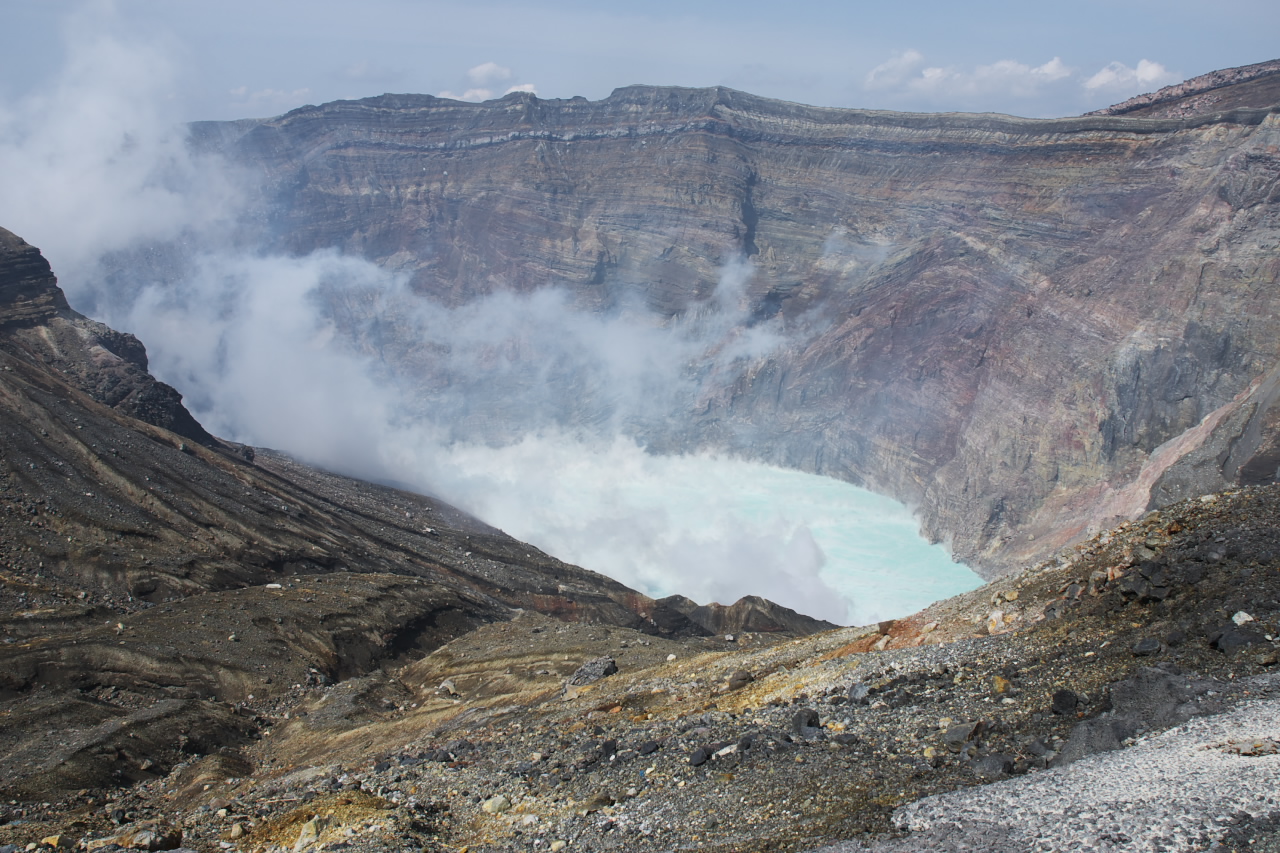
Mt. Aso Nakadake Crater
KumamotoAn active crater with a turquoise acid lake 100 m below the rim, reached by a toll road. Access depends entirely on the day's volcanic alert level.
Insider noteCheck the alert level the morning of, not the night before — level 1 means full rim access, level 2 restricts it, level 3 closes it. Gas masks are handed out free at the entrance and there are posted no-entry rules for people with asthma or heart conditions, which are enforced. If the crater is shut, Kusasenri — the grass plateau on the approach road with grazing horses and a pond — is not, and the 40-minute loop there is the fallback.
- 13:001 hour
Kusasenri Plateau (on the crater approach road)
A kilometre-wide grass meadow inside the caldera with horses grazing and the volcano behind — the most photographed Aso landscape.
Insider noteParking is a few hundred yen and the full circumference walk takes about 40 minutes with the mountain rotating behind you the whole way. This is where to eat: the plateau's restaurants serve akaushi, the local red beef, and it is the region's genuine specialty.
- 16:00rest of day
Kurokawa Onsen
KumamotoTwo dozen wooden ryokan along a forested river gorge. In the 1980s the village collectively rejected modernisation — no neon, no concrete towers — and built a shared bath-hopping system instead.
Insider noteThe wooden hopping pass (¥1,300) admits you to any three of 24 baths and is sold at the tourist information centre. Take a cave bath, a riverside rotenburo and a wooden-tub bath — that is the village's full range in three stops. Day-trip coaches occupy the village 11:00–15:00, which is precisely why you arrive at 16:00 and stay the night. Ryokan here start around ¥15,000 per person with dinner and book out months ahead for winter weekends.

- Kumamoto → Aso: about 70–90 min by road on the caldera route. The JR Hōhi line runs the same corridor if you are without a car.
- Crater access: the Aso toll road costs about ¥1,000 per car. There is also a shuttle bus from Aso Station (~40 min) when the crater is open.
- Aso → Kurokawa Onsen: about 50–60 min by mountain road, or roughly 90 min by bus from Aso Station.
- Mountain roads here need caution December–March; snow tyres are standard on winter rentals in Kyushu's interior.
Lunch is akaushi beef on the Kusasenri plateau. Dinner is at your ryokan and is included — this is the night the accommodation is the meal, typically a multi-course spread built on river fish and mountain vegetables.
Stay inside Kurokawa itself, not in Aso town. The village's whole argument is the early morning: at 6am mist comes off the river and the baths are empty, and day visitors cannot be there for it. This is the night to spend money on.
¥6,000–9,000 excluding accommodation: toll road ¥1,000, parking ¥500, bath pass ¥1,300, lunch ¥2,500–4,500. Ryokan ¥15,000–25,000 per person with two meals.
Yufuin's lake mist and Beppu's steam
Finish in Japan's densest hot spring country. A misty lake at dawn, a resort town that is half craft shops, then Beppu — where the ground vents so hard the city cooks food in it and eight distinct 'hells' are sold as a tour.
- 07:301 hour
Kinrinko Lake
OitaA small lake fed by both hot and cold springs, so it steams at dawn on cold mornings. There is a lakeside bath house on the shore.
Insider noteThe mist needs a cold morning and a still one — best October to March, effectively absent in summer. The lakeside loop is 15 minutes. Come before 8:30, because Yufuin's main street starts filling by 9:00 and this lake is at the end of it.
- 09:002 hours
Yufuin
OitaA hot spring town under the twin-peaked Mt. Yufu, whose main street is a mile of craft shops, roll cakes and soft-serve.
Insider noteYufuin is polarising: the main street is heavily commercialised and coach-fed, and the good version of the town is one street off it, where the galleries and small onsen actually are. If shopping streets are not your thing, cut this to 45 minutes and give the hour to Beppu instead.
- 12:302.5 hours
Beppu Jigoku Meguri (Hell Tour)
OitaEight 'hells' — vents and pools too hot to bathe in, kept as viewing sites. A cobalt-blue pond, a blood-red iron pool, a geyser on a schedule.
Insider noteThe combined ticket covers all eight but they split across two areas and doing every one is a long, repetitive afternoon. Umi Jigoku (blue), Chinoike Jigoku (red) and Tatsumaki (the geyser) carry the whole experience; four of the others can be skipped without regret. Buy the combination pass only if you genuinely intend five or more.
- 15:151 hour
Kannawa Steam Cooking
OitaJigoku-mushi — steam cooking. You buy raw seafood and vegetables and cook them yourself in a steam vent box.
Insider noteKannawa is the neighbourhood where Beppu's steam is domestic rather than touristic: it rises from drains and rooftops between ordinary houses. The steam-cooking centres charge for a basket and a vent slot, take about 20 minutes to cook, and are a genuinely good meal. Book a slot at the busier centres on weekends.
- 17:001 hour
Beppu Sand Bath
OitaBuried to the neck in naturally heated black sand on the beach at Kamegawa, under a wooden shovel and a supervising attendant.
Insider noteYou wear a supplied yukata and are buried for about 10–15 minutes, which is the recommended limit — it is much hotter under the sand than it looks. Bring a towel for your hair. Queues form late afternoon; the counter takes names and you wait, so put your name down first and use the bath house while you wait.
- 18:301 hour
Myoban Onsen
OitaThatched huts on a hillside where mineral crystals ('hot spring flowers') are still farmed from the steam by a 300-year-old method.
Insider noteHigher up the mountain than the rest of Beppu, cooler, and with the milky sulphur water the city is known for. The huts are a working operation, not a display. It makes a better last stop than the hells because it is quiet and you leave on that note.


- Kurokawa → Yufuin: about 60–75 min by mountain road. Buses exist but are infrequent — this is the leg that most needs the car.
- Yufuin → Beppu: about 45–60 min by road over the Yamanami highway, or 60 min on the JR Kyudai line, which is the scenic option if you are without a car.
- Beppu's own sights are spread across hillside neighbourhoods with a steep gradient between them; local buses connect them and a day pass is worth it if you have returned the car.
- Returning home: Oita airport is about 45 min from Beppu by bus; Hakata is about 2 hours by Sonic limited express if you are flying out of Fukuoka.
Lunch is the steam-cooking basket at Kannawa — plan around it rather than eating beforehand. Toriten (Oita-style tempura chicken) is the prefecture's everyday dish and the right last dinner.
If you have a night to add, Beppu's hillside ryokan in Kannawa or Myoban beat the seafront hotels: you get the sulphur water and the steam at the source.
¥8,000–13,000: hells combination pass ¥2,200 (or ~¥450 each), sand bath ¥1,500–2,000, Myoban bath ¥600–800, steam cooking ¥1,500–2,500, food ¥2,500–4,000.
Book before you leave home
- 1The Kurokawa ryokan is the single booking that constrains this trip — 2–3 months ahead for autumn and winter weekends, and it decides which day you drive to Aso.
- 2Rental car from Nagasaki with a Beppu or Oita drop-off. Confirm the one-way fee and, for December–March, that the car has winter tyres for the Aso and Kurokawa mountain roads.
- 3An International Driving Permit, obtained in your home country before departure. It cannot be issued in Japan and no rental desk will hand over keys without it.
- 4Shimabara–Kumamoto ferry: no reservation needed for foot passengers, but check the day's sailing times and whether your car fits the schedule.
- 5Nagasaki hotel — the city has fewer rooms than its visitor numbers suggest, especially around the August 9 memorial date.
- 6Nothing at Aso can be pre-booked, and that is the point: check the volcanic alert level the morning you drive up and have Kusasenri as the fallback.
Where the money goes
| Accommodation (5 nights)Includes one ryokan night at Kurokawa with meals, which alone is ¥15,000–25,000. | ¥55,000–110,000 |
| Rental car (days 4–6) + fuel + tollsPer car, not per person. Halves immediately with two travellers. | ¥25,000–35,000 |
| Rail (Hakata–Nagasaki) and local transport | ¥12,000–18,000 |
| Admissions & bathsHells, castles, sand bath, bath-hopping pass. | ¥10,000–13,000 |
| FoodTwo ryokan dinners are already inside the accommodation line. | ¥30,000–45,000 |
Per person unless a line says otherwise. Excludes international flights.
Shorter, longer, or a different season
- Without a car: keep days 1–3 exactly as written, then take the shinkansen to Kumamoto, the Hōhi line to Aso, the bus to Kurokawa, and the bus to Yufuin and Beppu. It works, but you lose the Itoshima coast on day 2 and the Shimabara route on day 4 — substitute a day trip to Yanagawa's canal punts and Mojiko's retro port instead.
- Cutting to 4 days: Fukuoka, Nagasaki, and then straight to Beppu. Drop Aso and Kurokawa together rather than one of them — they are the same half of the trip.
- Extending to 8: add the Takachiho gorge in Miyazaki (south of Aso, and the most spectacular single hour in Kyushu) and a night on the Kunisaki peninsula for the Rokugo Manzan temple circuit.
- In winter: Kurokawa's outdoor baths in snow are the best version of that village, but the Aso and Kurokawa mountain roads need winter tyres and daylight. Move the drive earlier and the crater to whichever day the alert level allows.
- In summer: swap the middle of each day toward the coast and the higher ground. Kyushu's July–August humidity makes the Nagasaki hill walks genuinely punishing before 16:00.
Journey times, fares and opening hours come from each spot's access information and are typical rather than guaranteed. Timetables, seasonal closures and volcanic alert levels change — confirm the legs your day depends on. Last revised 2026-07-24.
関連リンク
このコースで訪れるスポット
その他のモデルコース
- Kansai in 5 Days — The Quiet Side of the Golden Route
- Japan Alps to the Sea of Japan — 5 Days
- Tohoku in 5 Days — The Quiet North
- The Golden Route in 7 Days — Tokyo, Hakone, Kyoto, Osaka
- 5 Days in Kyushu — Volcanoes, Sand Baths and the Myth Coast
- 10 Days Beyond the Golden Route — San'in, Setouchi and Shikoku